The Agentic Operator: Run a One-Person Company Like a Ten-Person Team
Run a one-person company like a ten-person team. Build a standing stack of AI agents that own roles, not one-off chats, with you as the operator who verifies.
A collection of thoughts, reviews, and spiritual downloads.
Run a one-person company like a ten-person team. Build a standing stack of AI agents that own roles, not one-off chats, with you as the operator who verifies.
Engineer your day like a music producer builds a track: intro, build, drop, breakdown, and the silence that makes it hit. Energy management for creative work.
The harshest, least-skilled boss you'll ever work for is the voice in your head. How four levels of praise rebuild you from the source code up with self-talk.
Grief never marches straight to closure. The dual process model shows it swings between facing loss and rebuilding life, and that swing is how you survive.
Guilt is not moral reflection, it's an infinite loop trying to rewrite a read-only file. Stop paying server costs on an old version of you and ship forward.
Fear is not a warning, it's your brain pre-rendering a catastrophe that may never load, burning today's bandwidth on a future crash. Here is how to get it back.
Why foreign leaders in Thailand miss most of the bad news in the room, and four protocols that turn kreng jai from a costly blind spot into an advantage.
A four-level framework that turns praise from cheap sugar into minted social gold, and why Level 4 identity praise is the rarest, most powerful influence.
A biological playbook from the coral reef: how the tiny cleaner wrasse regulates sharks, and how to work with predatory bosses and clients without being eaten.
The decision framework that let pilot John Boyd win dogfights in worse aircraft, rebuilt for creators to collapse the lag between idea and shipped work.
A structured audit for detecting the fear, obligation, and guilt (F.O.G.) installed in you, plus four protocols to uninstall it without wrecking relationships.
What really happens in the grieving brain in the first six months after a major loss, and why every therapist, widow, and mortgage officer should know about it.
The Four Noble Truths, recompiled for infinite scroll: a 2,500-year-old Buddhist framework for understanding engineered craving and the attention economy.
The counterintuitive physics of abundance: why chasing money repels it, and three frequency shifts that move you from scarcity to wealth that tunes into you.
AI leverage for solo operators: a three-variable formula (Value x People x Often) for aiming generative AI, plus a 90-day plan to ship like a 100x-bigger team.
Harvard's decade-long research on generosity and longevity: the exact dosage that triggers the helper's high, and a four-quadrant map for where to give.
The invisible second job that arrives when a loved one dies: a 14-step tactical checklist for probate, insurance, and estate admin while you are still grieving.
How heat, humidity, jet lag, and caffeine withdrawal quietly drain a Western executive's IQ in tropical meetings, plus a pre-meeting protocol to fix it.
Cramer's Transactional Interpretation of quantum mechanics, retrocausality, and a protocol for treating your future self as a collaborator, not an outcome.
Why hoarding is a mathematical suicide pact, and how to trigger creative flow using the physics of the void by emptying space for new energy to rush in.
You don't need more motivation, you need a battery charger. A Human Manual excerpt on energy management: stop the debuff stack of caffeine without real rest.
How generative AI and spatial computing turn flat incremental game loops into immersive 3D worlds, living NPCs, and the next interface for human-computer play.
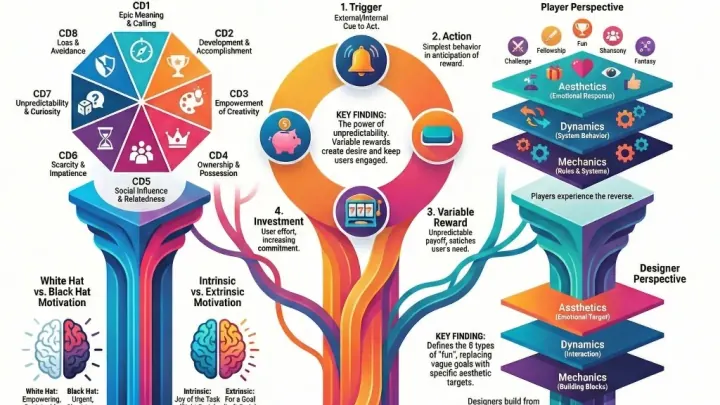
A deep analysis of the three pillars of behavioral design: Yu-kai Chou's Octalysis, Nir Eyal's Hook Model, and the MDA framework for engineering human behavior.
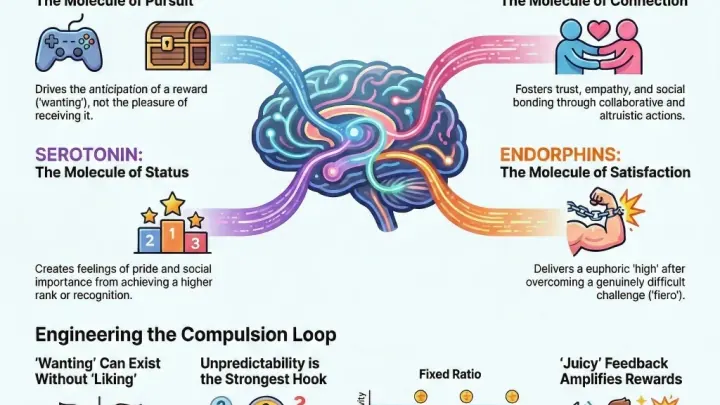
How the D.O.S.E. framework, dopamine, oxytocin, serotonin, and endorphins, is engineered into the interactive systems and games built to capture your attention.
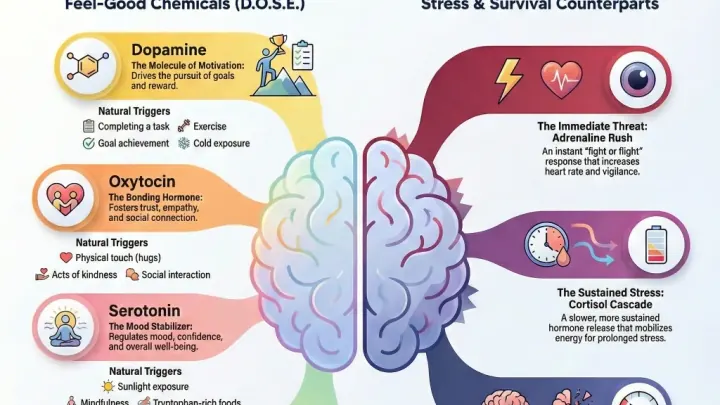
A deep analysis of the D.O.S.E. framework: how dopamine, oxytocin, serotonin, and endorphins, plus their homeostatic counterparts, govern emotion and drive.
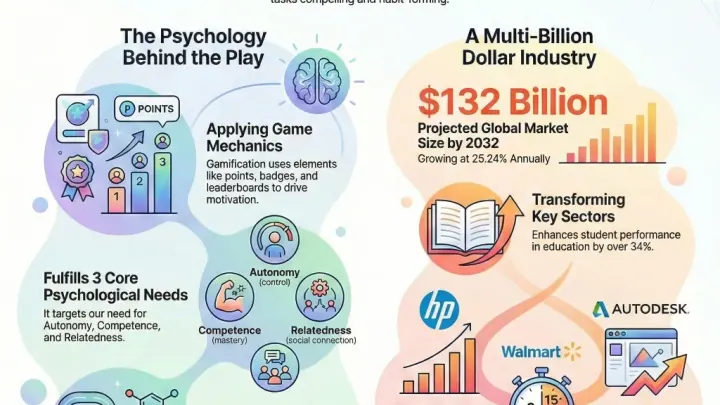
A deep analysis of gamification: its history from S&H Green Stamps to apps, the psychology and mechanisms that drive it, and how it is implemented worldwide.
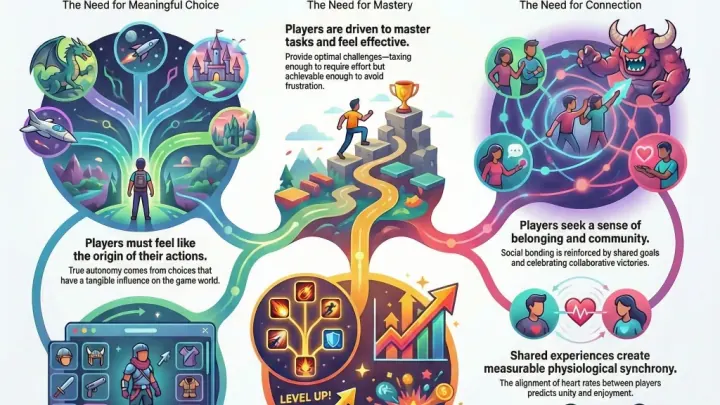
How Self-Determination Theory, autonomy, competence, and relatedness, became the Copernican turn in game design, replacing carrot-and-stick reward loops.
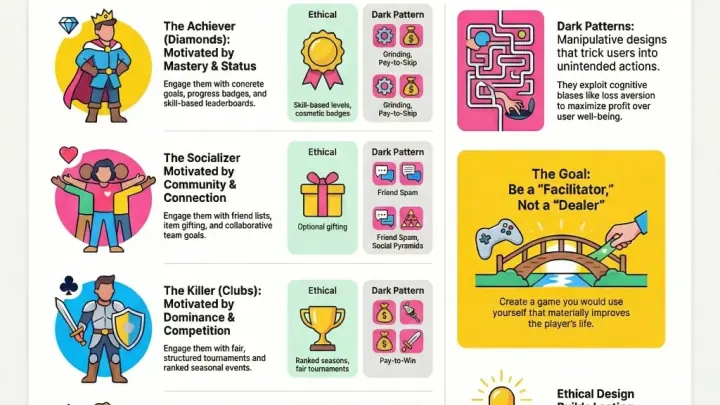
An analysis of mobile game design: Bartle's player typologies, the behavioral economics of free-to-play, and what sustainable, ethical engagement looks like.
An exhaustive analysis of relationship-based business in Thailand: how trust, hierarchy, and face shape commerce in a modern yet deeply personal economy.
Non-dual ontologies, recursive identity collapse, and deconstruction of the self, where Buddhist Anatta meets modern systems theory and ego death.
Quantum field theory, the observer effect, and non-local design: a report on how reality behaves less like fixed particles and more like a participatory field.
Why mai pen rai is Thailand's ultimate form of emotional intelligence, and how this single phrase can stop you overheating with stress in the Land of Smiles.
A complete system upgrade for being human: debug your reality, fix the headset that shapes perception, filter the feed you consume, and master the operator.
When the last person who remembers you as a child is gone: navigating the identity void after losing your parents, and the shift from lost child to guide.
Your anxiety is a hardware issue, not a character flaw. An exploration of the Vibe, the brain's prediction engine, and why low battery spams false errors.
You are in a war zone with no soldiers, only Fear, Obligation, and Guilt. An exploration of the F.O.G. Trap and key insights from the book Zero F.O.G. Given.