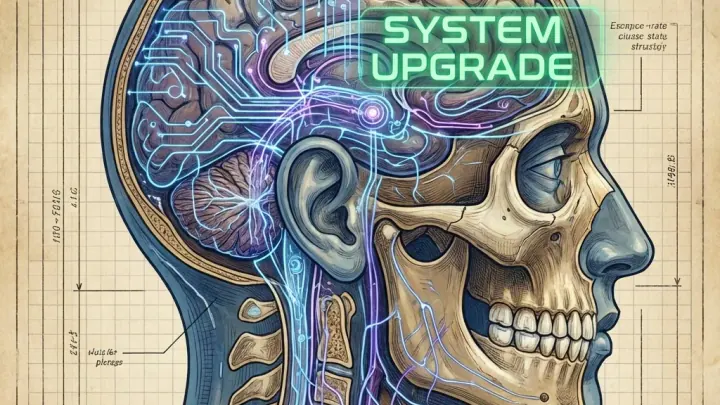
The Ronin Code
“A freelance knight without a master obeys only his own blade.”
— MrBee
You are standing in the cereal aisle of your own life, paralyzed, because someone else wrote your defaults.
Go to college. Buy the house. Be nice. Stay late. Don’t make it weird. You never chose any of it — you inherited it, the way a fresh install ships with bloatware you didn’t ask for and can’t figure out how to delete. Somewhere around age six you clicked “Accept” on Society’s Terms of Service — a document you did not read, could not have understood, and have been running on its settings ever since.
The symptom isn’t dramatic. It is quieter than that — a low, persistent hum of is this it? You hit every checkpoint they told you to hit and the reward screen never loaded. You optimized hard for a quest someone else assigned.
Here is what a missing internal code actually feels like: every decision costs full price. Should I take the job? Tell her the truth? Go to the party I dread? With no internal ruleset, each choice gets re-litigated from scratch — a fresh courtroom trial every time — and the verdict swings with your mood, your blood sugar, whoever spoke to you last. You are not steered by a compass. You are steered by external magnets, and the strongest magnet in the room always wins.
The Wave-Man and the Swordsman
Ronin. The literal Japanese translation is “wave-man” — a samurai cut loose from his lord, drifting wherever the current pushes. Most masterless samurai became exactly that: vagrants and mercenaries for hire to the highest bidder, loyal to nothing, blown sideways by every gust.
A rare few did the opposite.
Cut free from an external master, they installed an internal one — a private code of honor so exacting that no warlord, no bribe, no fear could move them off it. Miyamoto Musashi, the greatest swordsman Japan ever produced, spent his final days in a cave writing down his principles in The Book of Five Rings and a personal precept list he called Dokkōdō — “The Way of Walking Alone.” He did not wait for a master to hand him his values. He authored them and signed his name.
The wave-man and Musashi started from the same position — no lord, no external structure, no one watching. The difference was not talent. It was a document.
The Country Without a Constitution
A country without a constitution is not free — it is just up for grabs. Whoever holds power this week makes the rules, and they change them the moment it suits them. A constitution is the document that sits above the daily politics. It is the thing temporary law cannot override. It is why a real nation can survive a bad leader: the operating principles outrank the operator.
So run the diagnostic. What is your constitution?
If your honest answer is “I don’t have one — I just decide things as they come,” then read what you actually are. You are not a Sovereign Nation. You are a Colony. Someone else’s framework is running on your hardware, extracting your resources, and you are calling its rules your own personality. Your preferences are the preferences of the last strong opinion you encountered. Your standards shift with the social weather. Your north star is borrowed.
The Ronin’s move is to declare independence — not by leaving the world, but by writing the founding document the world never gave you, and refusing to let any temporary pressure amend it.
Why a Code Beats Willpower Every Time
Odysseus had himself lashed to the mast before the Sirens sang, knowing his future self would beg to steer into the rocks — so he bound the choice in advance, while he was sober and the threat was still abstract. Behavioral scientists call this a Ulysses contract: a precommitment made by a cool-headed present self on behalf of a future self who will be under pressure. The decision is made once, in conditions of clarity, and the future self simply executes.
This matters because decision-making is expensive. Re-litigating your values forty times a day — Should I check the phone? Should I skip training? Should I send the honest message or the safe one? — runs the processor hot on the same query, every single time, producing variable outputs depending on whatever depleted your resolve in the last hour.
A Player with a Code doesn’t deliberate at the decision point. He consults the document. Does this violate the Code? Yes. Then the answer is no. The decision was already made in a cool hour by a wiser version of him. Today’s job is only to obey it. The entire willpower budget is freed for execution.
The Ronin Code Protocol
This is the framework. The Ronin Code Protocol replaces the society-installed defaults with a constitution you authored. Three lines. Hard-coded. Non-negotiable.
Step 1 — Write Your “I Never”: A hard floor with zero exceptions. I never lie for money. I never raise my voice at someone smaller than me. I never check the phone before sunrise. The power is in the absoluteness. “Never” is a bright line, and a bright line is infinitely easier to hold than a “usually.” The moment you allow one exception, you have converted a constitution into a preference — and preferences bend.
Step 2 — Write Your “I Always”: A non-negotiable action regardless of mood, energy, or circumstance. I always create before I consume. I always keep my word, even the small ones. I always tell the difficult truth, kindly. This is not about being rigid. It is about having a self that is recognizable under pressure.
Step 3 — Write Your Tiebreaker (X over Y): When two goods collide — because they will — you need a pre-made decision. Freedom over comfort. Truth over harmony. The long game over the quick win. This line decides the hard cases the first two don’t cover. Write it now, so you don’t have to negotiate it in the moment the negotiating is hardest.
Step 4 — Retire the Courtroom: When the tough call lands, you no longer “think it over.” You consult the Code. The thinking-over phase is over. It happened when you wrote the document. Today’s job is to execute the ruling that was already made.
Step 5 — Post It Where It Matters: The Code lives where you make decisions. On the mirror. On the desktop wallpaper. On the notebook you open first. A constitution stored only in memory is a constitution that fades under pressure. The physical object is the mast you lash yourself to.
The Inversion
You started this post as a wave-man — shaped by external magnets, re-litigating identity with each new pressure system that rolls through.
The reframe: the absence of a master is not a problem to solve. It is a freedom to author.
The wave-man has no master — which means nothing is off-limits, which means nothing is decided, which means the strongest gust always wins. The Ronin also has no master — but the Code makes every decision in advance, which means the strongest gust hits a rock.
A Player with a Code is dangerous in the good way. He is predictable at the level of principle, and predictability at that level is the rarest trust signal there is. People relax around him because they know which way he’ll break under pressure. He cannot be bought because the price was never on the table.
He has stopped being a wave. He has become the rock the waves break on.
Write the three lines. Sign your name. Ship version one.
This essay draws from The Human Manual: 101 Cheat Codes, 101 executable thought experiments for hacking your operating system. Read more about the book →