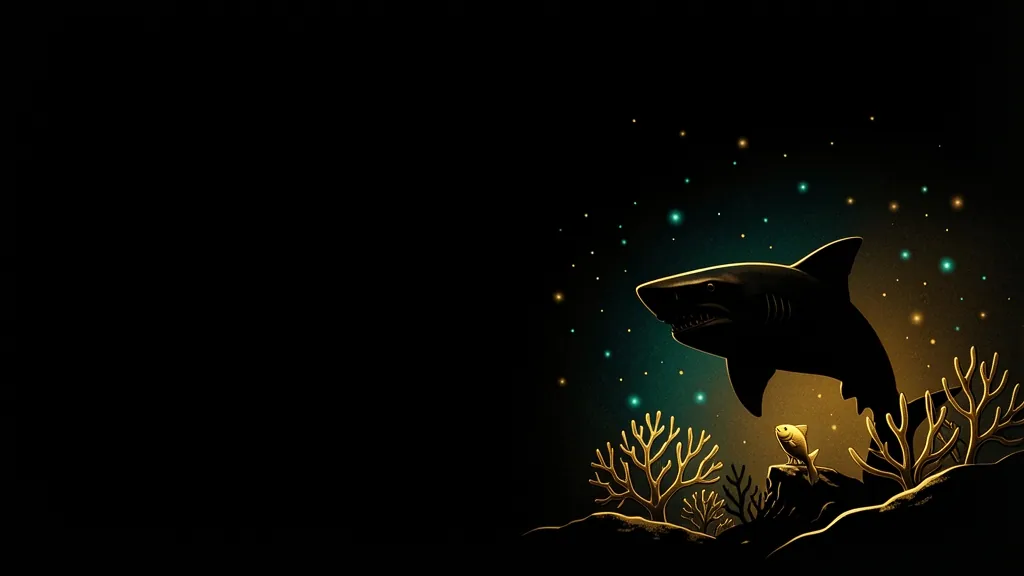
The Cleaner Fish Protocol: How to Work With Sharks Without Getting Eaten
“The shark does not eat the cleaner fish. Not because the shark is kind — but because the cleaner fish has become indispensable to the shark’s nervous system.”
On every healthy coral reef in the world, there is a small striped fish — no more than three inches long, with no teeth, no venom, and no armor — that swims directly into the open mouths of sharks.
It is called the cleaner wrasse (Labroides dimidiatus).
It spends its days picking parasites off the gills, tongues, and teeth of some of the most dangerous predators in the ocean. Sharks. Groupers. Moray eels. Manta rays. Fish that could swallow it whole without chewing.
And yet: in over fifty years of reef observation, researchers have almost never seen a cleaner wrasse be eaten.
The cleaner wrasse is the most useful case study in biological game theory ever discovered. It describes, with terrifying precision, how to work alongside predators in business, politics, and life — without becoming their dinner.
The Apparent Paradox
From the outside, the relationship looks insane. A fish with no defenses swims into a mouth with 300 teeth. Why doesn’t the shark just snap?
The answer lies in a mechanism biologists call tactile stimulation-induced parasympathetic activation — which, in plain English, means:
The cleaner fish calms the shark’s nervous system.
The act of being cleaned — having parasites picked off, having gills groomed — triggers the shark’s parasympathetic nervous system. The shark’s heart rate drops. Its stress hormones fall. It enters a state that researchers at the University of Queensland have measured and described as functionally equivalent to massage.
The shark does not eat the cleaner wrasse because the cleaner wrasse has made itself the shark’s regulator. The cleaner wrasse is, to the shark, what a really good deep-tissue massage therapist is to a stressed hedge fund manager: you do not eat your regulator.
You do not even consider it.
The Translation to Business
Most humans who work with “sharks” — aggressive bosses, dominant clients, high-ego competitors, family-business patriarchs — make one of two mistakes.
Mistake One: They try to fight. They match aggression with aggression. They bare their teeth. This is a losing strategy. The shark is bigger, better-connected, and has been swimming these waters longer. The fight is short, and the small fish loses.
Mistake Two: They try to hide. They become invisible. They take up no space. They avoid all contact. This also fails — not because the shark eats them, but because they become irrelevant. Invisibility is a survival strategy; it is not a success strategy.
The cleaner wrasse rejects both.
Instead, the cleaner wrasse makes itself the one thing the shark’s nervous system depends on.
The Four Moves of the Cleaner Fish
Move 1 — The Dance
Before entering the mouth of a shark, a cleaner wrasse performs a distinctive, undulating dance. It is a signal: “I am here to serve. I am not prey.”
In human business, this is the opening move of every high-status interaction. You do not walk into a powerful person’s office pretending to be their peer, and you do not walk in as a supplicant. You walk in with a signaling dance that says: “I am the person who makes this problem go away.”
This is not groveling. It is positioning. The cleaner wrasse does not apologize for its smallness; it advertises its function.
Move 2 — The Parasite Removal
The cleaner wrasse does not show up and make small talk. It arrives, identifies a parasite, and removes it.
In business, the translation is brutal and precise: find the parasite the shark cannot reach.
Every senior person has something eating them that they cannot deal with themselves. A political problem they cannot name publicly. A board member who is causing drag. A product defect they do not fully understand. An emotional regulation issue they will never admit to.
If you can identify that parasite — and remove it, quietly, without asking for credit — you have just initiated the nervous-system regulation that the cleaner wrasse depends on for survival.
You become useful. Not ornamental. Not pleasant. Useful in a way they cannot replace.
Move 3 — The Consistent Return
The cleaner wrasse maintains a fixed territory called a cleaning station. Sharks return to the same station, day after day, for years.
This is the move most ambitious humans get wrong. They perform one piece of useful work, get a taste of access, and then try to expand the relationship into something bigger, more social, more equal. They push. And the shark, sensing the breach of protocol, loses interest.
The cleaner wrasse stays at its station. It does not push. It is there, reliably, every day, doing the same precise function. The relationship deepens not through escalation but through reliability.
In a world of scarce trust, being the person who is always at the same station is a superpower.
Move 4 — The Boundary
Here is the most important move, and the one almost no one gets right:
When the shark is in a bad mood, the cleaner wrasse does not go into its mouth.
Researchers have documented this. On days when a shark is stressed, injured, or hungry, the cleaner wrasse simply stays outside the mouth. It performs the external cleaning. It does not risk the interior.
In business, this is the single move that separates survivors from statistics.
You must develop a calibration for when your shark is regulated and when they are not. The same request that lands well on Tuesday morning will get your head bitten off on Thursday afternoon. The cleaner wrasse does not take it personally. It reads the state and adjusts the depth of engagement.
This is not cowardice. This is nervous-system intelligence. It is the recognition that a dysregulated predator is not safe for anyone — including themselves — and that your job is to time your entry.
The Deeper Lesson
The cleaner wrasse reveals something that most leadership books miss: you do not need to be the biggest fish in the reef to be the most essential one.
You need to be the fish the biggest fish cannot live without.
That is not a matter of size, credentials, or connections. It is a matter of function. What parasite do you remove? What nervous system do you regulate? Whose day becomes measurably better because you exist in their orbit?
Answer those questions, build the cleaning station, stay there, and you will find that the sharks of your industry — the ones everyone else is terrified of — are the ones who will protect you most fiercely.
They are not being kind.
You have simply become indispensable to their regulation.
Swim into the mouth. Do the work. Come back tomorrow.
This essay draws from The Architecture of Abundance, a book on the structural laws of giving, receiving, and systemic flow. Read more about the book →