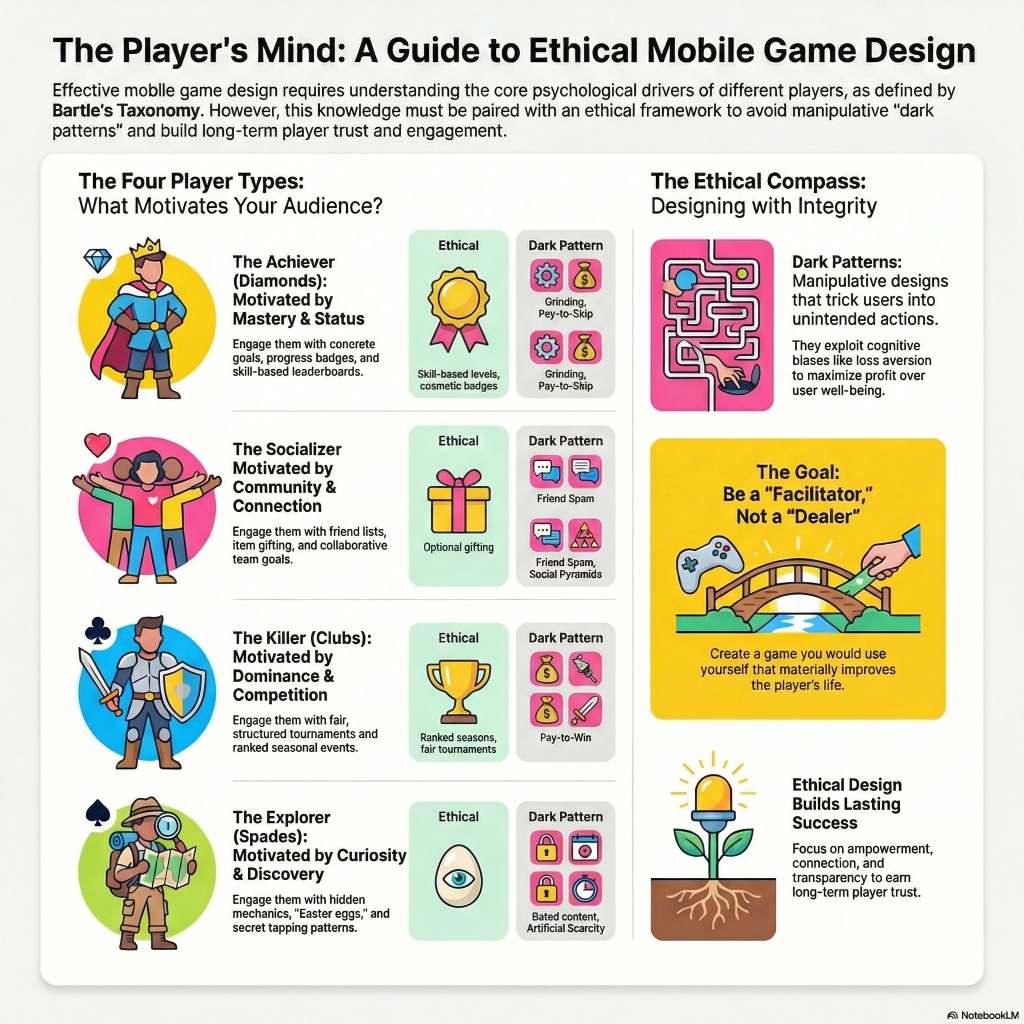
Theoretical Foundations of Mobile Game Design
Theoretical Foundations and Ethical Imperatives in Minimalist Mobile Game Design
The digital interactive landscape has undergone a profound transformation, shifting from complex, high-fidelity simulations to a pervasive ecosystem of minimalist mobile experiences. At the core of this transition is the emergence of the “tapping game” or “hyper-casual” genre, which relies on simple core loops to sustain engagement across diverse demographics. However, the apparent simplicity of these titles belies a sophisticated psychological architecture designed to appeal to specific player motivations while navigating a complex ethical terrain characterized by the tension between monetization and user welfare. This report examines the foundational principles of player typology as established by Richard Bartle, the implementation of behavioral mechanics to satisfy diverse personality profiles, and the critical ethical considerations surrounding dark patterns, the “playbor” debate, and the application of the Manipulation Matrix in sustainable game design.
The Architecture of Motivation: Bartle’s Taxonomy in Minimalist Contexts
The study of player behavior is fundamentally rooted in the taxonomy developed by Richard Bartle in 1996, which originally categorized participants of Multi-User Dungeons (MUDs) based on their preferred modes of interaction within a virtual world.[1, 2] While initially designed for complex multiplayer environments, this framework provides a robust lens for understanding the drivers of engagement in simple tapping games. The taxonomy is structured around two intersecting axes: the horizontal axis representing the preference for interacting with other players versus the game world, and the vertical axis representing the preference for acting on versus interacting with those entities.[2, 3]
The Achiever: The Suit of Diamonds and the Mastery Loop
Achievers, symbolized by the suit of Diamonds due to their relentless pursuit of treasure and status, are primarily motivated by concrete measurements of success.[1, 4, 5] In the context of a minimalist tapping game, the Achiever represents the primary engine of progress. These players derive satisfaction from the incremental increase of numbers, the acquisition of badges, and the unlocking of new levels.[1, 6] For the Achiever, the act of tapping is not merely a mechanical requirement but a pathway to mastery.
The psychological drive of the Achiever is closely aligned with the concept of “competence” within Self-Determination Theory (SDT).[7] They value 100% completion ratings and are often the most consistent users, as they are driven to maintain their status and points tally.[1, 6] In a simple game, providing clear feedback loops—such as visual counters, celebratory animations for level completion, and a “streak” system—is essential to satisfy this demographic.[1, 5, 8] Achievers often view the game world as a set of challenges to be “beaten,” and their engagement is sustained by the feeling that their skill is being validated through increasing difficulty and reward.[2, 6, 9]
The Socializer: The Suit of Hearts and Digital Relatedness
Socializers, represented by the suit of Hearts, prioritize human connection and empathy over the mechanical objectives of the game.[2, 4, 10] They constitute the vast majority of the player population, with research estimating that nearly 80% of individuals in certain gaming environments fall primarily into this category.[5, 10] For the Socializer, a tapping game serves as a social platform rather than a competitive arena. They are engaged not by the high score itself, but by the ability to see their friends’ scores, trade items, or collaborate on shared goals.[2, 11, 12]
The integration of Socializer mechanics into minimalist games often involves asynchronous social features, such as gifting “lives” or “energy,” visiting a friend’s virtual space, or participating in “friend-only” leaderboards.[11, 12] These features create a low-friction “social glue” that enhances retention without the high intensity of direct competition.[11, 12] Socializers are particularly responsive to community-building efforts and are often the most helpful members of a player base, assisting novices and spreading game-related knowledge.[2, 13]
The Killer: The Suit of Clubs and the Drive for Dominance
The Killer archetype, symbolized by the suit of Clubs, seeks to exert influence and dominance over other players.[2, 4] While they share an interest in status with Achievers, the Killer’s motivation is specifically tied to the relative loss or subordination of others.[5, 10, 14] In a tapping game, the Killer is motivated by the chance to outrank others on global leaderboards and to demonstrate their superiority in highly competitive events.[7, 10]
Killers represent a small but highly active segment of the population, often less than 1% of the total user base.[10] Despite their small numbers, they have a disproportionate impact on the game’s community dynamics. They are frequently the players who look for exploits, loopholes, or “pay-to-win” shortcuts to gain a competitive edge.[6, 15] To successfully integrate Killers into a game without alienating Socializers, designers must provide structured environments for competition, such as official tournaments or ranked seasons, where the Killer’s desire for dominance is channeled into a fair and regulated format.[7, 13]
The Explorer: The Suit of Spades and the Aesthetic of Discovery
Explorers, denoted by the suit of Spades, are motivated by curiosity and the desire to uncover the unknown.[1, 2, 5] In a minimalist game, where the world size is limited, the Explorer’s interest shifts toward the game’s “depth”—its underlying physics, hidden mechanics, and “Easter eggs”.[1, 4, 6] These players derive satisfaction from discovering secret animations or bonus content triggered by specific, non-obvious tapping patterns.[1, 16]
The psychological satisfaction for an Explorer comes from the feeling of being an “insider” with unique knowledge.[6] They are often the most patient players, willing to experiment with repetitive tasks if they believe a secret is buried beneath the surface.[10] Designing for Explorers in a simple game requires the inclusion of subtle meta-narratives, such as visual cues that change over time or hidden areas that only become accessible through non-linear play.[17, 18]
| Player Type | Suit | Core Action | Motivation Trigger | Social Dynamics |
|---|---|---|---|---|
| Achiever | Diamonds | Tapping for rewards | Points, levels, badges | Seek praise from Socializers |
| Socializer | Hearts | Interacting with peers | Friends’ scores, gifting | Collaborative and empathetic |
| Killer | Clubs | Dominating ranks | Global leaderboards, PvP | Competitive and disruptive |
| Explorer | Spades | Finding secrets | Easter eggs, tapping patterns | Individualistic discovery |
Table 1: Comparison of Bartle’s player types in the context of minimalist mobile games.[1, 2, 4, 5, 6, 13]
The Mechanics of Discovery: Integrating Easter Eggs and Hidden Animations
The inclusion of “Easter eggs”—hidden secrets that serve as a nod from the developer to the player—is a critical strategy for satisfying the Explorer demographic.[17, 19] These secrets function by fulfilling the player’s natural curiosity and providing a rewarding sense of discovery that transcends the primary gameplay loop.[17]
Designing for the Suit of Spades
For an Easter egg to be effective, it must balance challenge with discoverability. If a secret is too trivial, it fails to provide the sense of “competence” that Explorers crave; however, if it is impossible to find without external help, it may lead to frustration.[17] In minimalist mobile interfaces, where screen real estate is at a premium, secret tapping sequences are an ideal mechanism for discovery.[16, 20]
The Android operating system provides a prototypical example of this design philosophy. In almost every version of Android, navigating to the “About Phone” settings and repeatedly tapping the “Android Version” box triggers a unique animation or mini-game.[16, 20] These “digital Easter eggs” have evolved from simple images, such as the zombie gingerbread man in Android 2.3, to interactive experiences like the cat-collecting game in Android 7.0 or the nonogram puzzle in Android 10.[16, 20] Such mechanics satisfy the Explorer’s desire for “depth” by revealing that the interface is more complex than it initially appears.[4, 16]
Psychological Impact of Hidden Mechanics
The discovery of a hidden animation or secret “Easter egg” triggers an exciting dopamine response, reinforcing the player’s commitment to exploration.[17] Furthermore, these secrets can foster a sense of “relatedness” between the player and the designer. When a player recognizes a niche reference (e.g., to a literary work like Anna Karenina or a pop culture icon), they feel as though the designer shares their specific interests, creating a unique bond that enhances brand loyalty.[17]
The Ethical Landscape: Identifying and Mitigating Dark Patterns
As the gaming industry has evolved toward the “games as a service” model, the use of “dark patterns”—manipulative interface designs that trick users into actions they might not otherwise take—has become a significant ethical concern.[15, 21, 22, 23] These patterns exploit cognitive biases such as loss aversion and the sunk cost fallacy to maximize retention and monetization, often at the expense of the user’s well-being.[15, 21, 23]
Temporal Dark Patterns: Manipulation of Time
Temporal dark patterns focus on the player’s schedule and investment of time, often forcing them to play on the developer’s terms rather than their own.[22, 23]
- Playing by Appointment (Appointment Dynamics): This pattern requires players to return to the game at specific times to avoid negative consequences or to claim rewards.[21, 22] The classic example is found in Farmville, where crops wither and die if the player does not harvest them within a designated timeframe.[21] This mechanic weaponizes loss aversion, compelling the player to log in out of obligation rather than interest.[8, 21, 24]
- Grinding and Endless Loops: This involves designing a game so that progress is intentionally slowed down, requiring the player to perform repetitive, unchallenging tasks.[15, 21, 22] This “fun drudgery” is often a precursor to offering a “pay-to-skip” option, where the player’s frustration is monetized.[15, 21, 22]
Monetary Dark Patterns: The Commodification of Progress
Monetary dark patterns exploit the player’s desire for success and progress, often using deceptive language or obfuscated costs.[15, 22]
- Pay to Skip: Players are asked to pay money to bypass a difficult level or to avoid the “grind”.[21] This becomes unethical when the difficulty of the game is artificially spiked solely to push the player toward a purchase.[21, 23]
- Hidden Costs and Sneaky Subscriptions: This includes revealing service fees only at the final stage of a transaction or implementing “free trials” that automatically convert to paid subscriptions through an interface that makes cancellation difficult.[8, 15, 25, 26]
- Gated Content (Pay to Unlock): A strategy where a game arrives “incomplete,” forcing the player to pay to access the remaining content or to continue their progression.[21, 27]
Social Capital-Based Dark Patterns
Social dark patterns exploit the player’s relationships and social standing to drive game growth.[21, 22]
- Friend Spam and Impersonation: This occurs when a game uses a player’s social media permissions to send automated messages or “friend requests” in the player’s name without clear, informed consent.[21, 25] It can also involve using the names of real-life friends to falsely suggest they have performed certain in-game actions.[21]
- Social Pyramid Schemes: Mechanics that make it impossible to succeed or progress without inviting others to join the game, effectively turning the player base into a marketing force.[21, 22]
| Dark Pattern | Category | Psychological Mechanism | Example |
|---|---|---|---|
| Playing by Appointment | Temporal | Loss Aversion | Crops withering in Farmville [21] |
| Pay to Skip | Monetary | Frustration/Sunk Cost | Mighty Eagle in Angry Birds [21] |
| Confirmshaming | Psychological | Guilt/Social Norms | ”No, I’d rather bleed to death” [26] |
| Roach Motel | Interface | User Friction | Difficult cancellation of Amazon Prime [26] |
Table 2: Categorization of common dark patterns and their behavioral triggers.[8, 21, 22, 24, 26]
The “Playbor” Debate: Labor Theory in the Virtual Economy
The “Playbor” debate, a term derived from “play” and “labor,” examines whether the time and effort players invest in games constitute a form of exploitation.[28, 29, 30] This concept, popularized by Julian Kücklich, suggests that in many digital contexts, the distinction between work and play has become destabilized, creating hybrids where leisure activity generates value for third parties.[29, 30, 31]
The Labor Theory of Value in Gaming
Using Karl Marx’s Labor Theory of Value (LTV), researchers argue that players in free-to-play games are engaged in a form of labor.[28] In these virtual worlds, a player’s invested time and attention are transformed into valuable assets, such as digital currency or upgraded characters.[28]
- Surplus Attention and Surplus Value: In games like Monster Legends, players may watch 15-to-30-second rewarded advertisements to receive in-game benefits.[28] This “surplus attention” is sold by the game publisher to ad networks, generating “surplus value”.[28] In this arrangement, consuming the advertisement becomes indistinguishable from producing revenue, effectively turning the player’s leisure time into productive labor.[28]
- Systematic Undercompensation: Developers often pre-program “deficits” or resource shortages that can only be overcome through “grinding” or payment.[28] This creates a situation where players are consensually participating but are systematically undercompensated, as the game pushes them toward labor-like repetition to achieve their goals.[28, 30]
Modding as Precarious Playbor
The most cited example of playbor is “modding,” where fans create new content for existing games.[30, 31] While modders often derive great personal pleasure and social capital from their creations, the publishers usually retain all property rights and the exclusive right to profit from these modifications.[30, 31] This creates a precarious situation where the industry’s innovation is driven by unpaid labor that is perceived by the participants as mere play.[29, 31]
Navigating the Manipulation Matrix: An Ethical Compass
To ensure that a game is sustainable and not exploitative, designers can utilize Nir Eyal’s “Manipulation Matrix,” a decision-support tool designed to evaluate the morality of habit-forming products.[32, 33] The matrix evaluates design based on two fundamental questions: “Will I use the product myself?” and “Will the product materially improve the user’s life?”.[32, 33]
The Four Quadrants of Manipulation
- The Facilitator (Yes/Yes): This is the ethical gold standard. The designer creates a product they personally use and believe provides a material benefit to the user.[32, 33] This leads to the development of “healthful habits,” such as those found in exercise or learning apps.[33, 34, 35]
- The Peddler (No/Yes): The maker believe the product improves lives but does not use it themselves.[32, 36] This often results in a lack of empathy for the user and an “inauthenticity” that can lead to unintended harmful consequences.[32, 36, 37] Peddlers must be wary of a “savior complex” and perform extensive research to understand their audience’s true struggles.[32, 34]
- The Entertainer (Yes/No): The maker uses the product and finds it fun, but it does not solve a meaningful problem or improve the user’s life in a lasting way.[32, 36, 37] While healthy entertainment is valuable, these products are often fleeting and subject to fads, making them unsustainable for long-term engagement.[32, 37, 38]
- The Dealer (No/No): This quadrant is defined as pure exploitation.[32, 33] The designer does not use the product and does not believe it benefits the user; the only goal is to “hook” the user to extract money.[32, 33] Dealer-category products often leverage addiction-driven mechanics like those seen in casinos or predatory social media platforms.[32, 34]
| Quadrant | Uses the Product? | Materially Improves Life? | Ethical Standing |
|---|---|---|---|
| Facilitator | Yes | Yes | Ethical/Target [32] |
| Peddler | No | Yes | Well-intentioned but risky [32] |
| Entertainer | Yes | No | Sustainable as art/fun [32] |
| Dealer | No | No | Unethical/Exploitative [32] |
Table 3: The Nir Eyal Manipulation Matrix for evaluating design ethics.[32, 33, 34, 36, 37]
Case Study in Ethical Design: The Monument Valley Model
Monument Valley, developed by Ustwo Games, serves as a seminal case study in ethical retention and inclusive design.[39, 40] The game’s success—selling millions of copies and generating significant revenue—demonstrates that high-quality, non-exploitative games can thrive in the mobile market.[40, 41]
Aesthetics over Compulsion
Monument Valley prioritizes “sensory immersion” over “artificial rewards”.[40] The game features no villains, no fireballs, and no death; instead, the player guides the faceless Princess Ida through architectural mazes inspired by M.C. Escher.[39, 40, 42]
- Respect for Player Autonomy: Unlike many mobile games, Monument Valley contains no points to collect and no timing to respect.[42] The experience is “quiet and restrained,” avoiding the dopamine-heavy triggers common in hyper-casual titles.[40, 42]
- Minimal Friction Onboarding: The game focuses on reducing barriers to entry, making the mechanics intuitive so that “even a seven-year-old” or a non-gamer can understand the impossible geometry.[39, 43]
- Inclusive Audience Recognition: The development team consciously rejected the traditional stereotype of the “hardcore gamer,” aiming for an audience that includes “men and women and boys and girls and LGBT people” globally.[40] By focusing on art and storytelling rather than competitive dominance, they created a product that sits firmly in the Facilitator or Entertainer quadrants of the Manipulation Matrix.[32, 40, 42]
Toward a Sustainable Future: Integrating Ethics and Typology
Designing a simple tapping game that is both engaging and ethical requires a holistic approach that respects the diverse needs of different player types while rejecting the short-term gains of predatory design.[9, 44]
Strategy for Player Typology Integration
- Achievers (Diamonds): Incorporate clear progression markers. Implement a leveling system where each tap contributes to a visual goal, and reward milestones with cosmetic badges or non-mechanical achievements.[1, 5, 6]
- Socializers (Hearts): Focus on asynchronous connection. Allow players to see a “friend leaderboard” where they compete for local prestige rather than global dominance, and implement gifting mechanics that foster mutual benefit.[11, 12, 28]
- Killers (Clubs): Channel the competitive drive through structured systems. Offer a seasonal global leaderboard with fair, skill-based criteria, ensuring that dominance is earned through engagement rather than monetary spending.[7, 10, 13, 28]
- Explorers (Spades): Embed “mystery” within the interface. Use secret tapping sequences (e.g., tapping the four corners of the screen in order) to trigger hidden animations, color shifts, or a “secret level”.[16, 17, 20]
Ethical Design Recommendations
- Transparency and Fairness: Avoid “pay-to-win” situations. If monetization is present, it should focus on “vanity items” (e.g., skins or themes) or “rewarded ads” that the player chooses to watch, ensuring they remain the primary decision-maker.[27, 28]
- Neutral Voice and Respect for Time: IAP (In-App Purchase) menus should be presented in a neutral voice, and game characters should not be used to “shame” the player into spending.[26, 45] Avoid “appointment dynamics” that force play through loss aversion.[21]
- The Informed Customer Standard: Designers should ask if an “informed, rational customer” would still consider the game’s offer to be a beneficial exchange.[24, 28] If the retention mechanic relies on the player being “tricked” or “trapped,” it should be removed.[15, 24, 26]
In conclusion, the intersection of Bartle’s taxonomy and ethical behavioral design provides a comprehensive framework for the creation of sustainable mobile experiences. By aligning game mechanics with the intrinsic motivations of Achievers, Socializers, Killers, and Explorers, while simultaneously navigating the moral challenges posed by dark patterns and the playbor debate, developers can foster genuine engagement and long-term player trust. The goal of ethical design is not merely to “hook” users, but to facilitate a meaningful and positive experience that improves the user’s life through the power of play.[32, 34, 46]
Advanced Synthesis: The Convergence of Play and Value
The contemporary paradigm of game design suggests that the “simple tapping game” is no longer a trivial artifact of digital leisure but a complex site of psychological and economic exchange. As players move through the axes of Bartle’s taxonomy, they are not only seeking fun but are also participating in a sophisticated value-creation system.
The Role of Agency in Modern Playbor
The key distinction between a “fair” free-to-play game and an exploitative one often hinges on the preservation of player agency.[28] In a healthy ecosystem, the player’s labor (watching ads or grinding) is a voluntary choice made to enhance their specific experience.[28] Research indicates that 57% of gamers are accepting of advertising if it keeps the game free, provided they have the autonomy to decide when to engage with those ads.[28] When this agency is removed—through intrusive ads or forced appointment schedules—the “play” ceases to be an end in itself and becomes an alienated form of production.[30, 31]
The Aesthetic of Minimalism as Ethical Choice
Minimalism in game design, as observed in Monument Valley and other indie titles, serves both an aesthetic and an ethical function.[18, 39] By stripping away the “noise” of traditional high-friction mechanics (complex HUDs, constant notifications, aggressive monetization), designers allow the player to focus on the core sensory experience.[18, 40, 42] This approach respects the player’s time and cognitive load, positioning the game as a ” Facilitator” of relaxation rather than a “Dealer” of addiction.[32, 37, 42]
Strategic Implications for New Developers
For the developer of a new tapping game, success is found in the “Radiant Pattern”—the ethical alternative to the dark pattern.[47] A radiant pattern focuses on:
- Empowerment: Helping the player achieve mastery (Achiever) and discover secrets (Explorer).[17, 34]
- Connection: Facilitating genuine social bonds (Socializer).[11, 12, 34]
- Transparency: Being honest about costs, mechanics, and intentions.[15, 27, 34]
By adopting these principles, developers can move beyond the “fad” cycle of hyper-casual games and build enduring communities that value the product for its artistic merit and ethical integrity.[15, 32, 40] The shift from manipulative to meaningful design is not merely a moral imperative but a sound business strategy in an increasingly crowded and scrutinized market.[9, 15, 27]
Final Summary of Taxonomy and Ethics
The relationship between the player type and the ethical framework is summarized below to illustrate the potential pitfalls and healthy alternatives for each archetype.
| Player Archetype | Motivation | Potential Dark Pattern Exploitation | Ethical Implementation |
|---|---|---|---|
| Achiever | Mastery | Grinding, Pay-to-Skip, Energy Systems | Skill-based levels, cosmetic badges |
| Socializer | Relatedness | Friend Spam, Social Pyramids | Optional gifting, friend leaderboards |
| Killer | Dominance | Pay-to-Win, Unfair PvP imbalances | Ranked seasons, fair tournaments |
| Explorer | Curiosity | Artificial Scarcity, Gated content | Easter eggs, hidden animations |
Table 4: Ethical navigation of player motivations.[1, 11, 13, 15, 17, 21, 28]
This analysis underscores that the design of digital games is fundamentally a design of human experience. By understanding the suit of the player and the morality of the manipulation, designers can create virtual spaces that are as sustainable and respectful as they are engaging. The convergence of psychology, ethics, and minimalist aesthetics represents the next frontier in the evolution of interactive media.
Deep Dive into the Suit of Diamonds: The Mechanics of Persistence
The Achiever is not merely a player who likes points; they are individuals who seek to structure their reality through defined goals and measurable progress.[1, 2, 6] In a simple tapping game, the “score” serves as a proxy for the player’s time and dedication.[1, 6, 28] When a designer implements a badge system, they are not just providing a graphic; they are providing a milestone that validates the player’s persistence.[1, 5]
However, the Achiever is the most susceptible to the “Grinding” dark pattern.[15, 21, 22] Because they value completion, they may be lured into performing repetitive tasks that are no longer fun, simply to “100%” a game.[1, 21] This is where the ethical designer must intervene by ensuring that the “grind” is replaced with meaningful challenge.[8, 9] If the game requires the same action 10,000 times to unlock a badge, the designer should ask: “Does this behavior help the user achieve their goal of mastery, or am I just manufacturing engagement?”.[8]
Achievement as Status
For the multiplayer Achiever, status is a social currency.[1, 2] They seek to be at the top of the leaderboard not just for the sake of being there, but so that others (the Socializers) can see their accomplishment.[1, 2, 6] This creates a symbiotic relationship between player types: the Achiever provides the “elite” content and goals, while the Socializer provides the community and validation.[1, 2] If a game is too solitary, the Achiever may lose interest because there is no audience for their mastery.[1, 4, 6]
Deep Dive into the Suit of Spades: The Psychology of the Unknown
The Explorer’s drive is fundamentally different from the Achiever’s. While the Achiever wants to “beat” the game, the Explorer wants to “understand” it.[1, 2] They are the players who will spend hours tapping on non-interactive background elements to see if something happens.[6, 10] In a minimalist game, this curiosity is the greatest asset for retention.[5, 10, 13]
Implementing Tapping Patterns as “Deep Mechanics”
Secret tapping patterns function as a form of “hidden complexity”.[4, 16] For example, if tapping a specific sequence (e.g., Long Press -> Double Tap -> Swipe Left) triggers a hidden animation of the protagonist dancing, the Explorer feels they have achieved a “secret win”.[16, 17, 20] This удовлетворяет their need for autonomy because they discovered this content through their own volition, not because the game told them to.[17, 46, 48]
Designing these patterns requires a “subtle but impactful” approach.[17] The designer should use visual or auditory cues—such as a slight change in a sound effect or a brief shimmer on a sprite—to hint that there is more to be found.[17, 18, 43] This creates a “riddle” that the Explorer is eager to solve.[1, 4, 17]
Deep Dive into the Suit of Hearts: Collaboration over Competition
The Socializer constitutes the backbone of long-term player retention.[5, 10, 11] While Achievers and Killers may come and go based on the current “meta” or difficulty, Socializers stay because of the people.[2, 5, 11] In a simple tapping game, the social layer must be “low friction” to avoid overwhelming the casual nature of the platform.[12, 43, 49]
Asynchronous Social Mechanics
Minimalist games should avoid demanding real-time social interaction, which can be high-pressure.[43, 49] Instead, asynchronous features like “gifting” or “helping neighbors” are highly effective.[11, 12] In Farmville or Hay Day, checking in on a neighbor’s farm is a small act of kindness that strengthens social ties without requiring direct communication.[10, 11] This satisfies the “Relatedness” need in SDT, making the player feel connected to a community.[7, 46]
Deep Dive into the Suit of Clubs: The Ethics of Global Competition
The Killer is often the most controversial archetype, yet they are essential for creating a “dynamic” game world.[2, 4] Without the threat or challenge of a Killer, the game can become stagnant.[4] However, the designer must prevent the Killer’s behavior from becoming predatory.[6, 21]
Global Leaderboards and Competitive Balance
A global leaderboard is the primary motivator for a Killer in a simple game.[7, 10] To keep this ethical, the leaderboard must be transparent and fair.[15, 27] If a Killer can “buy” their way to the top through Pay-to-Win mechanics, the competitive integrity is destroyed, and the Killer’s satisfaction is actually reduced because the “victory” was not earned.[15, 27, 28] Ethical competition requires a level playing field where skill and dedication are the only variables.[12, 27, 28]
The Dark Side of Design: A Deeper Look at Cognitive Biases
Dark patterns do not work because players are “unintelligent”; they work because they weaponize the very cognitive shortcuts our brains use to survive.[15, 23, 50]
- Loss Aversion: Our brain is wired to feel the pain of loss more intensely than the joy of gain.[8, 21, 24] When Farmville tells a player their crops are dying, it triggers a biological “stress” response that overrides the player’s rational decision to stop playing.[21, 24]
- Sunk Cost Fallacy: Once a player has invested time or money (Playbor), they feel they “must” continue to make the investment “worth it”.[8, 24, 30, 51] Dark patterns like “Playing by Appointment” take advantage of this by making the player feel that missing a day is “wasting” their previous month of effort.[21, 22, 24]
Conclusion: The Path of the Facilitator
The ultimate goal for a developer creating a simple tapping game is to occupy the “Facilitator” quadrant of the Manipulation Matrix.[32, 33] This means creating a game that the developer plays themselves (because it is genuinely fun) and that improves the user’s life (by providing relaxation, social connection, or cognitive challenge).[32]
By aligning the Suits of Diamonds, Hearts, Clubs, and Spades with ethical design practices, we can move toward a future where “Free to Play” does not mean “Free to Exploit.” Instead, it represents a new era of digital entertainment that is as sustainable as it is delightful.[9, 15, 27, 28]
- Bartle taxonomy of player types - Wikipedia
- Bartle’s Taxonomy of Player Types (And Why It Doesn’t Apply to Everything) | Envato Tuts+
- Together Learning - Bartle taxonomy of player types
- Players Who Suit MUDs - Richard A. Bartle
- The Four Player Types in Gamification - Plecto
- Understanding Your Audience - Bartle Player Taxonomy - GameAnalytics
- Different Types of Gamers And How to Adapt to Them - Game Design Skills
- Chapter 33: Dark Patterns and Ethical Business Design - The Strategy Engine: Business Models, Unit Economics & Moats
- Beyond Predatory Practices Ethical Game Design and Player Retention in the Gaming Industry - ResearchGate
- Bartle’s Player Types for Gamification | IxDF - The Interaction Design Foundation
- Understanding Types of Gamers for Smarter Game Design - Innovecs Games
- Your Ultimate F2P Game Design Handbook is Here — Proven Insights From 10 Years XP in Designing F2P Games (1/4) | by Genesis - Medium
- Types of Gamers: a Full Taxonomy of Player Types in 2025 - INLINGO
- Applying Game Theory/Design to Writing: Bartle Types : r/gamedesign - Reddit
- The Ethics of Dark Patterns in Game Design - GameDesignKnowledge
- Hidden Game on Android Phones Unveiling Digital Easter Eggs - You Should Know
- Designing Perfect Easter Eggs in Video Games: Tips and Tricks - Try …
- Minimalism in Game Design: Examples, Tips, and Ideas | Envato Tuts+
- Bartle’s Player Types for Gamification | IxDF - The Interaction Design Foundation
- Every Android Easter egg and how to find it
- Dark Patterns in Game Design – Educational Game Design
- Level Up or Game Over: Exploring How Dark Patterns Shape Mobile Games - arXiv
- Dark Patterns in Games: An Empirical Study of Their Harmfulness - SciTePress
- Exploitative Game Design: Beyond the F2P Debate - E McNeill
- 12 Types of Dark Patterns That Trick You Online - Game Quitters
- 18 Dark Patterns Examples That Manipulate Users (and How to Avoid Them) - Eleken
- The Dark Side of Gaming: An Interview on Ethical Monetization - Wayline
- Are Free-to-Play Games Evil? Reopening the Debate on … - Paidia
- Playbour, farming and labour | Ephemeral Journal
- [Gamification, Playbor & Exploitation - Cyborgology - The Society Pages](https://thesocietypages.org/cyborgology/2012/10/15/gamification-playbor-exploitation-2/
- Precarious Playbour: Modders and the Digital Games Industry - ResearchGate
- Using the Manipulation Matrix for Ethical Behavioral Design - Designli
- Morality of Manipulation in a More Addictive World | NirandFar
- Navigating Ethical Design: Understanding Nir Eyal’s Manipulation Matrix - Medium
- How Nir Eyal’s habit books are dangerous - Axbom
- Blog 27: Evaluating the morality behind manipulating users (Hooked model)
- The morality of manipulation. Are you a Facilitator or a Dealer? Or… | by Marika Zammartino
- Hooked: How to Build Habit-Forming Products By Nir Eyal with Ryan Hoover
- The Real-World Architecture of Monument Valley - The Casual Optimist
- Magical Experiences: Monument Valley – Designer Fund
- The accidental, inimitable success of Monument Valley - GamesIndustry.biz
- MONUMENT VALLEY the aesthetic experience of an inclusive (no)game | by giulia simi | Medium
- Designing for Minimal Friction in Player Onboarding - Game Wisdom
- Beyond predatory practices : ethical game design and player retention in the gaming industry - DiVA portal
- How to prevent ‘purposefully neglectful’ UI/UX dark patterns in F2P mobile games
- Levelling Up Ethics: Video Game Design and Global Responsibility
- A Game of Dark Patterns: Designing Healthy, Highly-Engaging Mobile Games | Request PDF - ResearchGate
- Supporting Users’ Influence in Gamification Settings and Game Live-Streams - Publikationen der UdS - Universität des Saarlandes
- Casual Game Design (Fundamentals, Levels, Mechanics)
- A Comprehensive Study on Dark Patterns - arXiv
- Ethics of Game Monetization : r/gamedev - Reddit