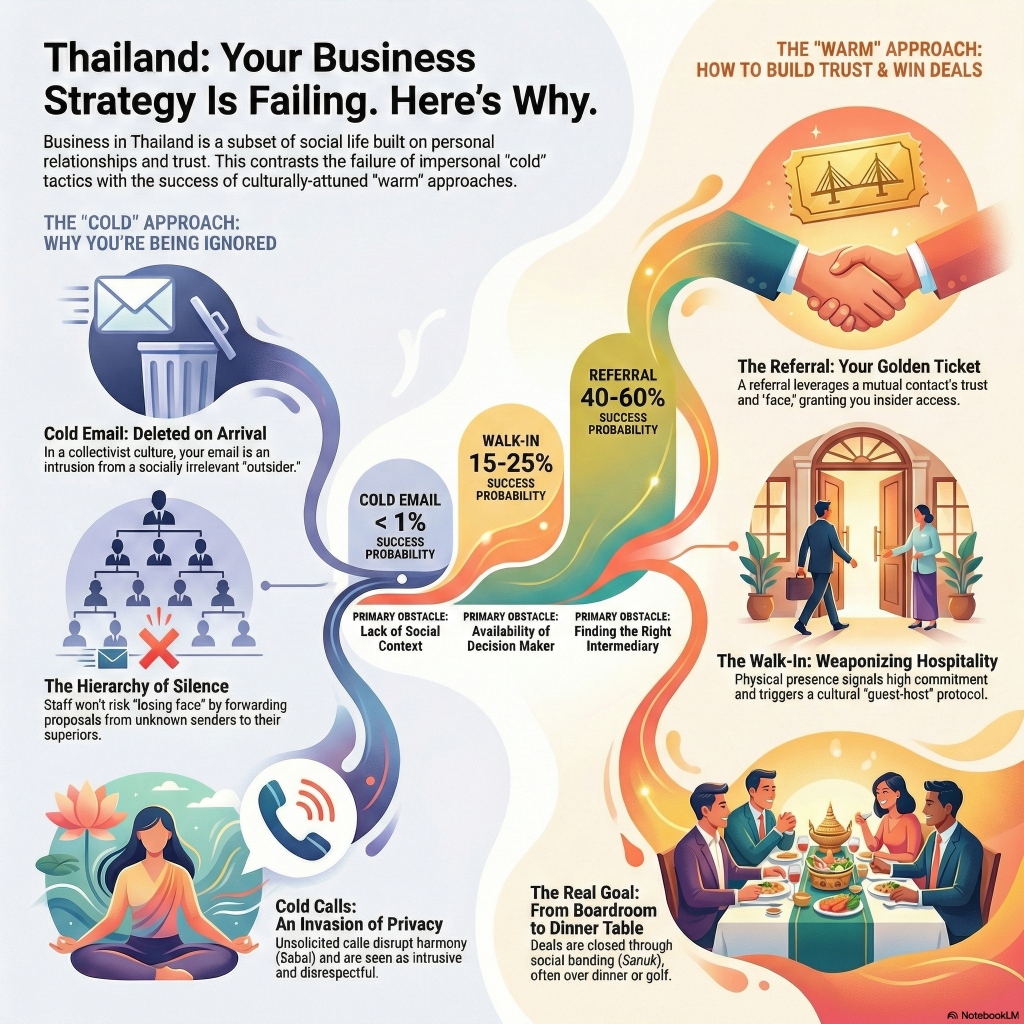
The Sociology of Commerce in the Kingdom of Thailand
The Sociology of Commerce in the Kingdom of Thailand: An Exhaustive Analysis of Relationship-Based Business Dynamics
Executive Summary
The Kingdom of Thailand presents a distinct paradox within the global economic landscape: it is a nation boasting advanced industrial infrastructure, high digital penetration, and significant integration into global supply chains, yet its fundamental mechanisms of commercial exchange remain deeply rooted in pre-modern, agrarian sociological constructs. While the “hardware” of the Thai economy is global—characterized by 5G networks, mass transit systems, and multinational industrial estates—the “software” running it is intensely local, governed by a “Trinity of Thai Social Interaction”: Kreng Jai (consideration/deference), Bunkhun (indebtedness/reciprocity), and Sanuk (social pleasure).
This report provides a comprehensive examination of why Thailand functions as a relationship-based culture rather than a rule-based one. It dissects the systemic failure of “cold” Western methodologies—specifically cold emailing and telemarketing—and validates the superior efficacy of “warm” approaches such as referrals, physical walk-ins, and face-to-face networking. The analysis draws upon Hofstede’s cultural dimensions, Edward T. Hall’s high-context communication theories, and contemporary case studies of business success and failure in the Thai market. The evidence indicates that in Thailand, trust is not an abstract legal concept derived from contracts or institutional competence, but a somatic and emotional state derived from physical proximity, shared experience, and the transfer of social capital through intermediaries. Consequently, the digital efficiency of email is rendered ineffective by the cultural inefficiency of low-context communication, making the physical presence of the “Walk-In” or the social collateral of the “Referral” indispensable assets in the Thai business ecosystem.
1. The Sociological Bedrock: Why “Business” is “Personal”
To understand why a cold email is deleted while a walk-in is entertained, one must first dismantle the invisible scaffolding of Thai social psychology. In Western markets, particularly in the Anglosphere, business is often conceptualized as a distinct sphere of activity, separate from social life, governed by impersonal laws and market efficiency. In Thailand, this separation does not exist. Business is simply a subset of social interaction, subject to the same rigorous codes of hierarchy, face, and obligation that govern family and community life.
1.1 The Collective vs. The Atomized Individual
The fundamental unit of Thai society is not the individual, but the group—the family, the university cohort, the company team, or the clique. This collectivist orientation, confirmed by Hofstede’s dimensions where Thailand scores very low on Individualism (Index 20), has profound implications for business outreach.
In an individualistic culture (like the US or UK), a cold email is viewed as a transaction between two autonomous agents. The recipient evaluates the proposal based on its merit: “Does this product save me money?” If the answer is yes, a meeting is granted. The identity of the sender is secondary to the value of the proposition.
In a collectivist culture like Thailand, a cold email is viewed as an intrusion by an “outsider” (a non-member of the group) into the “insider” sphere. Because the sender has no pre-existing connection to the group, they have no social identity. They are, sociologically speaking, a non-person. The group protects itself from the uncertainty of the outsider by closing ranks and ignoring the intrusion. Trust is not extended to strangers; it is reserved exclusively for the in-group. Therefore, the goal of market entry in Thailand is not to “sell” a product, but to transition from “outsider” to “insider.” A cold email cannot achieve this transition because it carries no social currency. A referral, however, acts as a bridge: the intermediary, who is already an “insider,” vouches for the outsider, temporarily transferring their trust and allowing the outsider to enter the circle.
1.2 The Hierarchy of Silence and Decision Making
Thailand scores notably high on the Power Distance Index (64), indicating a society where inequality is expected and accepted. This manifests in the workplace as a steep, rigid hierarchy where decision-making power is concentrated almost exclusively at the top. Subordinates—gatekeepers, junior managers, and even mid-level executives—are often disempowered from making decisions that involve risk or change, such as engaging a new, unknown vendor.
When a cold email lands in the inbox of a mid-level Thai manager, it places them in a position of discomfort. To act on the email, they would need to approach their superior with a proposal from a stranger. If the stranger turns out to be unreliable, the manager loses “Face” (social standing) for having wasted the boss’s time or introduced a risk. Given the high Uncertainty Avoidance (Index 64) in Thai culture, the risk of engaging with the unknown far outweighs the potential reward of the product.
This structural reality creates a “Hierarchy of Silence.” The subordinate’s safest course of action is to do nothing. Silence preserves the status quo. It avoids the risk of bothering the boss (violating Kreng Jai) and avoids the risk of personal failure. Thus, the cold email is not rejected because the product is bad; it is rejected because the internal social cost of processing it is too high for the recipient.
1.3 The “System Trust” Deficit
In developed Western economies, there is a high degree of “System Trust.” One trusts that a stranger sending a business email is likely a legitimate entity because the legal system punishes fraud, and corporate governance is standardized. In Thailand, despite modernization, “System Trust” remains lower than “Personal Trust”. The legal system can be slow and unpredictable for commercial disputes, particularly for foreigners.
Consequently, Thai business people rely on “Relational Security” rather than legal security. They prefer to do business with people they can see, touch, and vet personally. If a partner cheats them, the recourse is not a lawsuit, but social ostracization—the loss of reputation within the network. A cold emailer exists outside this network and therefore has no “reputational collateral” to pledge. They are perceived as high-risk. A walk-in or a referral provides physical or social proof of existence, reducing the perception of risk.
2. The Mechanics of Exclusion: Why Cold Channels Fail
The user’s query posits that “cold email is worse.” The research overwhelmingly supports this, not merely as a preference but as a systemic inevitability. The failure of cold channels (email, phone) is driven by the incompatibility between the medium and the message in a high-context culture.
2.1 The “Threat Detection” of Asynchronous Text
Psychologically, cold emails trigger a “threat detection” response in the brain, which is amplified in high-context cultures. In Thailand, where social harmony (Kwaam Sa-ngob) is prized, an unsolicited demand for attention from a stranger is viewed as a form of aggression.
- The Language of No-Context: Email is a “Low-Context” medium. It conveys only text. It strips away all the cues a Thai person uses to navigate social interaction: the tone of voice, the posture, the dress code, the smile, and the setting. Without these “High-Context” markers, the Thai recipient is socially blind. They cannot assess the status of the sender relative to themselves. In a hierarchy-obsessed culture, not knowing who is “higher” or “lower” induces anxiety. To resolve this anxiety, the recipient deletes the email.
- The Cognitive Load of English: While English is the language of global business, for many Thai professionals it remains a second language requiring effort to process. A cold email from a foreigner imposes a “cognitive tax” on the recipient. Unless there is a compelling social reason to pay this tax (e.g., a request from a friend), the recipient will default to ignoring it.
2.2 The Intrusiveness of the Cold Call
If cold email is ignored, the cold call is often actively resented. Thai culture places a high value on Sabai (comfort/ease) and the preservation of a private sphere.
- The Privacy Barrier: In Thailand, mobile phone numbers are often treated as semi-private property. Receiving a sales call on a mobile line is frequently perceived as an invasion of privacy, a disruption of Sanuk (pleasure), and a violation of boundaries.
- The “Face” Trap: A cold call forces an immediate reaction. The recipient must either accept the pitch (which they don’t want to do) or reject it (which causes them discomfort because Thais dislike saying “No” directly). This forces the recipient into a “Face-threatening” situation. To avoid this awkwardness, they will cut the call short or simply not answer unknown numbers.
- The Gatekeeper Defense: Thai receptionists and secretaries view their primary role as protecting their boss’s “Face” and time. A cold caller with no referral has no status. The gatekeeper effectively filters these out to demonstrate their own competence and loyalty to the hierarchy.
2.3 The Digital Trust Gap
Despite high internet usage, there is a lingering skepticism towards “virtual-only” entities in the Thai B2B sector. A company that exists only as a website and an email address is viewed as ephemeral. It lacks “substance.”
- Verification through Presence: Thais value tangible assets. A business card, a physical office, a face-to-face meeting—these are proofs of reality. A cold email is easily faked. A human being standing in the lobby is harder to fake. This physical verification is a crucial step in the due diligence process for Thai buyers.
3. The Power of Presence: Walk-Ins and the “Guest” Protocol
The user suggests that a “walk-in might be better.” This is a counter-intuitive insight for Westerners accustomed to appointment-only cultures, but it holds significant validity in specific Thai contexts, particularly within the SME (Small and Medium Enterprise) and industrial sectors.
3.1 The “Guest-Host” Cultural Reflex
Thai culture is deeply hospitable. The concept of Ton Rab (welcoming guests) is ingrained in the social psyche.
- Weaponizing Hospitality: When a foreigner walks into a Thai office, smiles, and politely asks to speak to a manager, they trigger the “Guest-Host” protocol. The receptionist or gatekeeper finds it much harder to dismiss a smiling, physically present guest than to delete an email. To turn a guest away rudely would be to lose Face and demonstrate a lack of breeding.
- The “Sawatdee” Effect: A walk-in allows the visitor to perform the Wai (the traditional Thai greeting). This simple physical act communicates respect, cultural intelligence, and non-aggression. It immediately lowers the “threat” level and establishes a human connection that text cannot replicate.
3.2 Visual High-Context Data
The walk-in provides the Thai decision-maker with the high-context data they crave.
- Physiognomy and Dress: Thais judge character by appearance. A visitor who is well-groomed, wears a suit in the heat (showing respect), and has a calm demeanor (Jai Yen) is instantly accorded a level of trust. The “physiognomy” of the salesperson—their vibe—is often as important as the product they are selling.
- Commitment Signaling: Showing up in person signals that the vendor is serious. They have invested time, travel costs, and effort. In a relationship-based culture, effort is a proxy for reliability. A cold email costs nothing and therefore signals zero commitment. A flight to Bangkok and a taxi to an industrial estate signal high commitment.
3.3 Limitations of the Walk-In
It is crucial to nuance this strategy. The “Walk-In” is highly effective for:
- SMEs and Family Businesses: Where the owner is often on-site and the decision-making chain is short.
- Factories and Industrial Estates: Where “sales engineers” dropping by is a recognized industry practice.
- Service Sectors: Where the “personal touch” is part of the product.
However, for large conglomerates (e.g., CP Group, PTT, SCG) or government ministries, a walk-in is less likely to yield an immediate meeting due to strict security and protocol. In these cases, the Referral becomes the mandatory key, as discussed in Section 4.
4. The Currency of Connection: Bunkhun, Sen-Sai, and Referrals
If the walk-in leverages hospitality, the referral leverages obligation. This is the most powerful force in Thai business.
4.1 Bunkhun: The Debt of Gratitude
Bunkhun is a psychological indebtedness that binds Thai society together. It is not merely “gratitude” in the Western sense; it is a long-term obligation to repay a favor.
- The Referral Mechanism: When a mutual contact (the intermediary) introduces a foreign vendor to a Thai buyer, they are spending their Bunkhun capital. The buyer grants the meeting not necessarily because they are interested in the product, but to repay the debt of gratitude they owe to the intermediary.
- The “Face” Transfer: The intermediary effectively lends their “Face” to the stranger. The buyer treats the stranger with the same respect they would accord the intermediary, at least initially. This creates a “safe zone” for the first meeting, free from the suspicion that plagues cold calls.
4.2 Sen-Sai: The “Strings” of Power
Sen-Sai translates to “strings” or “lines.” It refers to the invisible web of connections—family, university alumni (especially Chulalongkorn or Thammasat), and political alliances—that structure Thai society.
- Navigating the Matrix: In Thailand, the formal organizational chart is often a fiction. The real decision-making power flows through Sen-Sai. A manager might technically be in charge of procurement, but the decision might actually be made by an advisor who is the owner’s uncle. A cold email hits the formal chart (the manager). A referral navigates the Sen-Sai to reach the real power.
- The Role of the “Fixer”: This explains the prevalence of local “consultants” or “agents” in Thailand. These individuals do not necessarily have technical expertise; their value lies entirely in their Sen-Sai. Foreign firms hire them not to do the work, but to open the doors that remain locked to outsiders.
4.3 The “Face” Economy in Negotiations
Negotiations in Thailand are governed by the need to preserve “Face” (Raksa Na) for all parties.
- The Rejection Problem: In a cold outreach scenario, silence is the preferred method of rejection because it is “Face-saving.” It avoids the awkwardness of a direct “No.”
- The Meeting Trap: In a face-to-face meeting arranged by a referral, a Thai partner will almost never say “No” to a proposal. They will smile, nod, and say “It is interesting.” This is often misinterpreted by Westerners as a “Yes.” In reality, it is a polite deferral to avoid causing the guest to lose Face. The true answer is only revealed later, often through the intermediary or through prolonged silence.
- Project Management Implications: In project execution, Face is critical. If a project is failing, a Thai subordinate may not report the failure to a foreign manager via email, as this would cause the manager to lose Face (by receiving bad news) and the subordinate to lose Face (by admitting failure). Bad news is only delivered face-to-face, where the blow can be softened with body language and Kreng Jai. Without face-to-face relationships, a foreign project manager is often the last to know the truth.
5. The Digital Paradox: LINE vs. Email
While cold email is ineffective, it would be a mistake to view Thailand as technologically backward. Thailand is a “mobile-first” nation with some of the highest social media engagement rates in the world. The rejection of email is not a rejection of technology, but a rejection of low-context, asynchronous technology in favor of high-context, synchronous tools.
5.1 The Dominance of LINE
The LINE application is the de facto operating system of Thai business, used by over 54 million people. It has largely replaced email for day-to-day communication.
- Emotional Bandwidth: Email is emotionally sterile. It is hard to convey Kreng Jai or Sanuk in text. LINE, with its vast library of stickers (cute characters, bowing bears, respectful cartoons), allows Thai users to inject emotion and softness into business communication. A manager can send a command followed by a smiling sticker to signal “I am the boss, but we are still friendly.” This restores the “high context” that email strips away.
- Synchronicity and Flow: Thais prefer the “flow” of conversation over the “batch processing” of email. LINE allows for real-time, back-and-forth exchange that mimics face-to-face interaction. It feels more “human” and less “corporate.”
5.2 The “Group” as a Decision Engine
LINE Group chats are essential for project management. They mirror the collective nature of Thai work culture.
- Consensus Building: A decision can be “floated” in a LINE group to gauge the mood of the team without anyone having to take the risk of a formal proposal. It allows for soft consensus building, whereas an email demands a hard “Reply.”
- The “Shadow” Organization: Real work happens in the LINE group, not in the email thread. A foreign manager who insists on “email only” for documentation purposes will often find themselves cut out of the actual information loop.
Table 1: The Communication Spectrum in Thai Business
| Channel | Cultural Fit | Success Probability | Primary Obstacle | Mechanism of Action |
|---|---|---|---|---|
| Cold Email | Very Low | < 1% | Kreng Jai (Ignoring is easier), Lack of Context | Purely informational (Low Context); triggers “Outsider” defense. |
| Cold Call | Low | 1-5% | Privacy invasion, Gatekeepers, Sabai disruption | Aggressive Intrusion; forces awkward “Face” choices. |
| LinkedIn Msg | Low-Medium | 5-10% | Perceived as “Western” style; accepted by MNCs | Professional Networking; slightly better than email due to profile visibility. |
| Walk-In | Medium-High | 15-25% | Availability of decision maker, Security | Guest-Host Protocol; Visual Trust; Demonstrates Commitment. |
| Referral | Very High | 40-60% | Finding the intermediary | Bunkhun (Reciprocity); Transfer of Trust; Face Insurance. |
| Dinner/Golf | Extremely High | > 80% (for closing) | Cost, Time, Access | Sanuk (Pleasure); Relationship bonding; “Third Place” interaction. |
6. Case Studies: The Cost of Coldness vs. The Value of Warmth
Real-world examples illustrate the stark difference between relationship-based and transaction-based strategies in Thailand.
6.1 The Failure of Uber: Algorithm vs. Relationship
Uber’s struggles in Thailand provide a cautionary tale of “Cold Tech” meeting “Warm Culture.”
- The Mistake: Uber attempted to impose a sterile, algorithmic, cashless system on a transportation market dominated by informal, deeply networked human systems (Motorcycle taxi queues, Songthaews). Uber relied on the “efficiency” of their app (cold technology) and ignored the local “turf” and regulatory relationships.
- The Culture Clash: Uber’s cashless model clashed with the cash-preference of Thai consumers (a tangible trust mechanism). More importantly, they failed to build Sen-Sai with local regulators and stakeholders. They were viewed as an arrogant foreign entity disrupting the local ecosystem.
- The Outcome: Uber was eventually forced to sell its Southeast Asian operations to Grab. Grab succeeded because it localized intensely, accepting cash, working with taxi drivers (building relationships), and navigating the regulatory Sen-Sai more effectively.
6.2 Thailand 4.0: The Policy vs. The Practice
The Thai government’s “Thailand 4.0” initiative aims to digitize the economy. While this promotes digital adoption, it has created a schism.
- The Conflict: Foreign tech firms often assume Thailand 4.0 means they can sell software via email. They fail.
- The Reality: While the policy is digital, the procurement remains analog. The decision-makers in large conglomerates and government ministries are often older men who operate on Bunkhun and golf. They may buy the latest AI software, but they will buy it from the vendor who took them to dinner, not the one who sent the best whitepaper. The “Old Guard” controls the budget, and they respond to relationships, not cold outreach.
6.3 SME Success: The “Walk-In” King
Anecdotal evidence from the Thai industrial sector (e.g., Amata City, Rayong) shows that the most successful foreign sales representatives are those who adopt the “Walk-In” strategy.
- The Method: These reps drive to industrial estates, knock on factory guardhouses, offer energy drinks or snacks to the guards (building low-level Bunkhun), and ask to see the plant manager.
- The Result: They get meetings because they are physically present in a location where “being there” is 90% of the battle. They respect the hierarchy by starting at the gate and working their way up, rather than trying to jump over the gate with an email to the CEO.
7. Sector-Specific Dynamics
The effectiveness of relationship channels varies by industry, though the “Cold” approach is universally weak.
7.1 Manufacturing and Industrial Supply
- Dynamic: High reliance on “Walk-Ins” and “Technical Sales.”
- Why: Factory managers are practical people. They value a vendor who can physically inspect a broken machine now. A cold email cannot fix a machine. Presence is the product.
- Relationship Focus: Long-term supply contracts are often maintained through regular visits and gifts (whiskey, fruit baskets) during New Year and Songkran festivals.
7.2 Government and Public Sector
- Dynamic: 100% Relationship and Sen-Sai based.
- Why: Procurement is bureaucratic and risk-averse. Officials will strictly avoid “unknown” vendors to prevent accusations of corruption or incompetence.
- Method: A “Walk-In” is impossible here due to security. Referrals are the only entry point. The “middleman” or “local partner” is mandatory to navigate the bidding process.
7.3 Consumer Services and Hospitality
- Dynamic: High reliance on Social Proof and Sanuk.
- Why: This sector sells “Face” and “Pleasure.”
- Method: Partnerships are formed at social events, parties, and product launches. A vendor who doesn’t show up to the party effectively doesn’t exist. “Cold” sales are ignored; “Warm” social media engagement (influencer marketing, which is a form of digital referral) is highly effective.
8. Strategic Roadmap: From “Cold” to “Warm”
Based on this analysis, the user is advised to abandon cold email strategies in favor of a “Relationship-First” approach. The following roadmap outlines how to operationalize these cultural insights.
Phase 1: The “Warm” Entry (The Setup)
- Map the Sen-Sai: Do not buy email lists. Invest in memberships with local Chambers of Commerce (AustCham, AMCHAM, BCCT) or industry associations (Federation of Thai Industries). These are the “authorized” gathering places of the “In-Group”.
- The “Third Party” Approach: Use LinkedIn not to pitch, but to identify mutual connections. Reach out to the mutual contact: “I see you know Khun Somchai. I am visiting Bangkok next month; could you introduce us?” This leverages the Bunkhun of the intermediary.
- Hire a “Face”: If budget allows, hire a local Business Development Manager. Their primary KPI should not be “emails sent” but “lunches had.” They are your cultural interface, translating your “Low Context” product into a “High Context” relationship.
Phase 2: The Physical Offensive (The Visit)
- The “Sawatdee” Tour: Plan a physical trip to Thailand. Frame meetings as “Courtesy Calls” or “Listening Tours” rather than sales pitches. This aligns with Thai humility.
- The Walk-In (Tactical): For SMEs/Factories, dedicate days to physical canvassing. Dress formally (suit and tie, despite the heat). Bring high-quality business cards (bilingual) and present them with two hands (a sign of respect).
- The Gift Economy: Bring small, high-quality gifts (Omiyage style) from your home country. This initiates the Bunkhun cycle immediately. It creates a small debt of gratitude that makes it harder for the recipient to ignore you later.
Phase 3: The “Third Place” Closing (The Deal)
- Move to the Table: Once a connection is made, invite the prospect to lunch or dinner. Always pay the bill. In Thai culture, the host/inviter pays. Splitting the bill (“American Share”) effectively kills the relationship as it signals cheapness and a transactional mindset.
- Golf Diplomacy: If the prospect is senior, golf is the ultimate accelerator. It provides 4-5 hours of captive “High Context” interaction. It builds the Sanuk and Sabai that lubricates the deal.
Phase 4: Digital Maintenance (The Follow-up)
- The LINE Transition: After the first meeting, ask: “May I add your LINE?” This moves you from the “Cold” zone (Email) to the “Warm” zone (Chat).
- Soft Touches: Use LINE for relationship maintenance—sending industry news, New Year greetings, or stickers—rather than hard sales pressure.
9. Conclusion
The hypothesis that “cold email is worse” in Thailand is not merely correct; it is a fundamental truth of the market’s sociological structure. Thailand operates on a “Relation-Based” operating system where trust is somatic, hierarchical, and reciprocal. The efficiency of a cold email is an illusion in Bangkok because it fails to account for the exorbitant transaction cost of establishing trust in a high-context, risk-averse culture.
By ignoring the “cold” channels and embracing the “warm” channels of Referral, Walk-In, and Face-to-Face interaction, a business aligns itself with the gravitational forces of Thai culture—Kreng Jai (consideration), Bunkhun (gratitude), and Sanuk (pleasure)—rather than fighting against them. In the Thai market, you do not close a deal; you open a relationship. The deal is merely the byproduct of that opening.
Appendix: Cultural Dimensions Data Table
Table 2: Cultural Dimensions Comparison (Thailand vs. USA/West)
| Dimension | Thailand | USA/West | Implication for Business Outreach |
|---|---|---|---|
| Power Distance | 64 (High) | 40 (Low) | Subordinates wait for orders; Westerners take initiative. Cold emails to lower staff hit a dead end. |
| Individualism | 20 (Low) | 91 (High) | Thais trust the Group/Connection; Westerners trust the System/Contract. Referrals are mandatory. |
| Uncertainty Avoidance | 64 (High) | 46 (Low) | Thais fear the unknown/risk; Westerners tolerate it. Walk-ins provide visual reassurance. |
| Long-term Orientation | 32 (Low/Mid) | 26 (Low) | Focus on tradition and fulfilling social obligations (Face) over immediate profit. |
Bibliography
- Thai culture and its effects on organizational engagement in Thai privately held companies, http://www.ijbejournal.com/images/files/16465202695c5d4cf46d060.pdf
- Thai Cultural Dimensions Scores Source: https://www.hofstede-insights.com
- Work Culture in Thailand: Traditions and Modern Practices | NNRoad, https://nnroad.com/blog/work-culture-in-thailand/
- Respect and Hierarchy: Navigating Thai Workplace Relationships - AustCham Thailand, https://www.austchamthailand.com/resources/news/respect-and-hierarchy-navigating-thai-workplace-relationships
- Business culture in Thailand - myNZTE, https://my.nzte.govt.nz/article/thai-business-culture
- A cultural comparison of business practices in Thailand and Japan, https://www.tandfonline.com/doi/full/10.1080/23311886.2017.1370994
- Managing In Thailand – Management Style & Workplace Culture - Commisceo Global, https://commisceo-global.com/management-guides/thailand-management-guide/
- Cultural Diversity | Organizational Behavior - FlatWorld, https://scholar.flatworldknowledge.com/books/31289/fwk-122425-ch02_s02
- Demystifying “Kreng Jai”: Navigating Thai Corporate Culture - Hyperwork, https://www.hyperworkrecruitment.com/post/demystifying-kreng-jai-navigating-thai-corporate-culture
- Affect-based dimensions of trust: a study of buyer-supplier relationships in Thai manufacturing - ResearchGate, https://www.researchgate.net/publication/377626675_Affect-based_dimensions_of_trust_a_study_of_buyer-supplier_relationships_in_Thai_manufacturing