The Architecture of Human Motivation
The Architecture of Human Motivation: A Comprehensive Analysis of Self-Determination Theory in Digital Game Systems
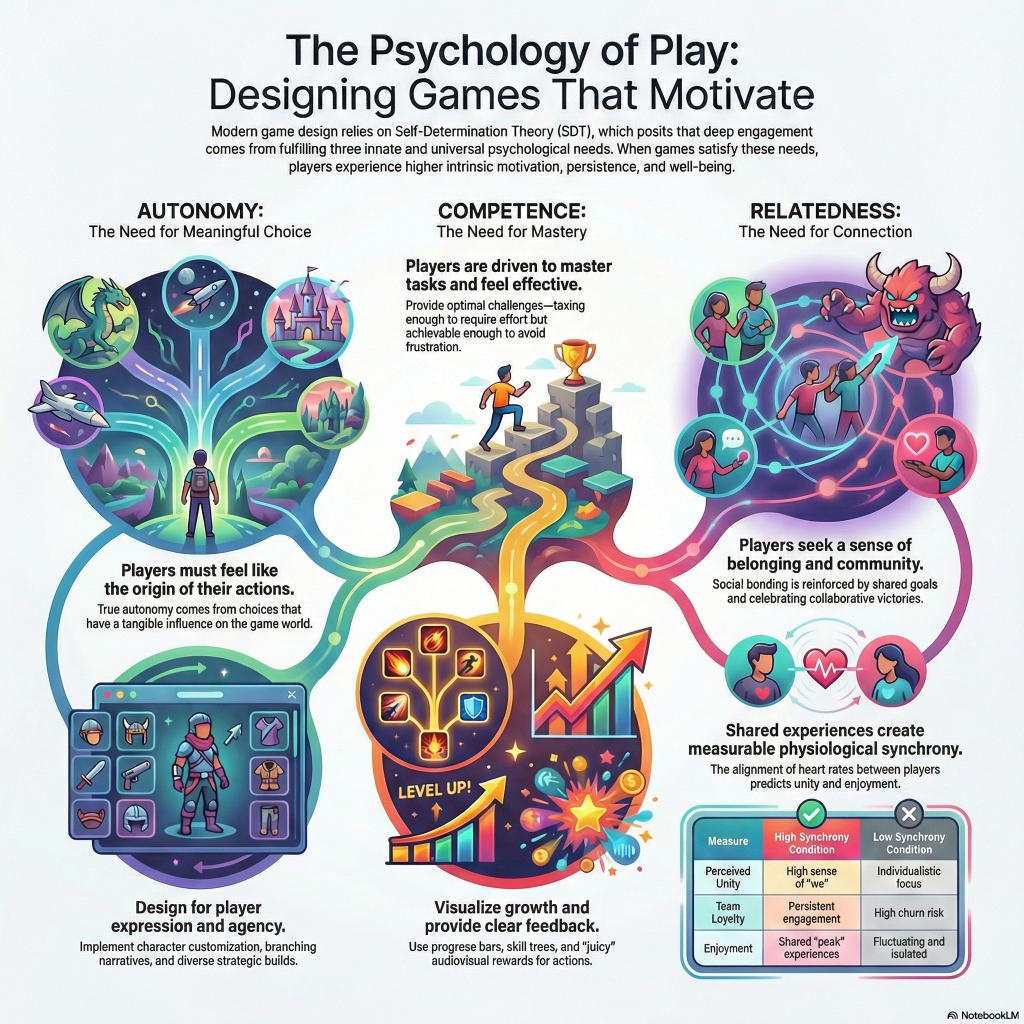
The evolution of digital interaction from simplistic arcade loops to sophisticated psychological ecosystems necessitates a profound understanding of the internal drivers that govern human behavior. At the epicenter of this understanding lies Self-Determination Theory (SDT), a macro-theory of human motivation, personality development, and wellness that has transcended its origins in clinical psychology to become the foundational framework for modern game design.[1, 2, 3] Developed over four decades by Richard Ryan and Edward Deci, SDT posits that the quality of human engagement is not merely a function of external rewards or behavioral conditioning, but is fundamentally dependent on the satisfaction of three innate, universal psychological needs: autonomy, competence, and relatedness.[1, 3, 4] When these needs are fulfilled within a digital environment, players exhibit higher levels of intrinsic motivation, persistence, and psychological well-being; conversely, when these needs are thwarted, the result is amotivation, alienation, and churn.[2, 4, 5]
The shift toward SDT-driven design represents what researchers have termed a “Copernican turn” in the field of motivation.[3] It moves the focus away from the role of reinforcement—the “carrot and stick” approach of traditional behaviorism—and toward the inherent human propensity to learn, explore, and master challenges.[3] In the context of game design, this transition requires a granular examination of how mechanics, feedback systems, and social structures interface with the human neurobiological and psychological architecture.
The Theoretical Continuum of Motivation and Internalization
Central to the application of SDT is the recognition that motivation is not a binary state but a complex spectrum of regulatory styles.[1, 4] This continuum ranges from amotivation, characterized by a lack of intentionality or perceived value, to intrinsic motivation, where an activity is performed for its inherent interest and enjoyment.[3, 5] Between these poles lies extrinsic motivation, which is further subdivided based on the degree to which the external goal has been internalized into the individual’s sense of self.[1, 4]
The process of internalization is critical for long-term engagement in digital games, particularly in systems that require repetitive actions or “grinding”.[6] When a player begins an activity for an external reward, such as a gold coin or a badge, they are initially in a state of external regulation.[4] However, if the game environment supports the three basic psychological needs, the player may transition through introjected regulation (avoiding guilt or seeking ego-enhancement) and identified regulation (recognizing the personal importance of the task) until they reach integrated regulation, where the behavior is fully congruent with their values and identity.[1, 4]
| Motivational Regulation | Locus of Causality | Regulatory Processes | Design Implementation |
|---|---|---|---|
| Amotivation | Impersonal | Non-valuing, incompetence, lack of control | Poor onboarding, high barrier to entry |
| External Regulation | External | Compliance, external rewards and punishments | Initial quest rewards, daily login bonuses |
| Introjected Regulation | Somewhat External | Self-control, ego-involvement, internal rewards | Streaks, leaderboards, “don’t miss out” alerts |
| Identified Regulation | Somewhat Internal | Personal importance, conscious valuing | Skill trees, specialized character roles |
| Integrated Regulation | Internal | Congruence, awareness, synthesis | Guild leadership, community-driven events |
| Intrinsic Motivation | Internal | Interest, enjoyment, inherent satisfaction | Core gameplay loop, exploration, sandbox play |
Research indicates that autonomous forms of motivation—those toward the internal end of the spectrum—predict an array of positive outcomes across varied contexts, including higher persistence, greater creativity, and enhanced well-being.[2, 5] For game designers, the objective is to create environments that facilitate this shift from controlled to autonomous motivation, ensuring that the “psychological pull” of the game remains robust even in the absence of constant external reinforcement.[7, 8]
Autonomy: The Engine of Volition and Player Agency
Autonomy is defined as the experience of perceiving oneself as the origin of one’s behaviors, acting with a sense of choice and self-endorsement.[1, 4, 9] Within the video game industry, autonomy is often operationalized as “agency,” though academic research distinguishes between the two: autonomy represents the volitional decision-making at the moment of choice, while agency refers to the temporal unfolding of the consequences of those decisions.[9, 10] A truly autonomy-supportive game does not merely provide a plethora of options; it ensures that those options are meaningful and that the player’s intent is consistently reflected in the game’s outcomes.[9]
Customization and Aesthetic Self-Expression
One of the most immediate methods for supporting player autonomy is the provision of customization options.[10, 11, 12] By allowing users to alter the appearance of their avatar, their equipment, or even the central interactable elements of the game—such as the texture and sound effects of a “red button”—designers provide an avenue for identity expression.[1, 12] This form of “aesthetic autonomy” has been shown to enhance enjoyment and emotional resonance, as it allows the player to shape the digital world in a way that reflects their personal preferences.[10, 12, 13]
However, the impact of customization on the overall experience is nuanced. Experimental studies involving Super Mario Bros. Crossover demonstrated that while the ability to customize character aesthetics significantly correlated with increased enjoyment, it did not always result in a measurable increase in perceived autonomy or objective performance for all users.[12] This suggests that customization is most effective when it is perceived not as a superficial task, but as a meaningful extension of the player’s agency within the world.[9] Furthermore, prior experience with a game genre can moderate this effect; players familiar with the mechanics are more likely to utilize customization as a tool for strategic optimization, thereby deriving a greater sense of autonomy from the process.[12]
Narrative Agency and Structural Choice
In more complex game systems, autonomy is supported through narrative paths and branching storylines.[10] Titles such as The Witcher 3: Wild Hunt and Mass Effect are frequently cited as exemplars of agency-driven design, where players make significant moral and strategic choices that fundamentally alter the trajectory of the game world.[10] This form of “narrative control” transforms the player from a passive consumer of a story into an active contributor to its development.[10]
The significance of this participant autonomy cannot be overstated; when individuals feel that their choices have a tangible influence on the virtual realm, their commitment of both time and emotional energy intensifies.[10] Conversely, the “illusion of choice”—where multiple options lead to the same outcome—can result in profound player disappointment and a breakdown of the motivational structure if discovered.[10] To maintain true autonomy, designers must balance the constraints of the game’s formal system with the freedom of the player to act intentionally.[9]
| Type of Control | Mechanism | Design Example | Impact on Autonomy |
|---|---|---|---|
| Aesthetic Control | Customization of visual/audio assets | Character skins, button colors, sound packs | Identity expression, enjoyment |
| Strategic Control | Diverse character builds and roles | Skill trees, class-based systems | Sense of ownership over playstyle |
| Moment-to-Moment Control | Responsive, “tight” controls | Movement mechanics, precision aiming | Sensation of power and mastery |
| Narrative Control | Impactful story decisions | Branching dialogue, multiple endings | Long-term emotional commitment |
| World Control | Modifying the environment | Building mechanics, sandbox exploration | Creative agency, investment |
The Risks of Controlling Environments
Self-Determination Theory also highlights the social-contextual conditions that can undermine autonomy.[2, 3] Environments that are overly rigid, punitive, or rely heavily on surveillance and external pressure are perceived as “controlling” rather than “supportive”.[2, 4] In gaming, this might manifest as systems that force players down a singular path, punish minor mistakes with disproportionate severity, or use “dark patterns” like compulsory timers and aggressive monetization to coerce engagement.[6, 8]
When autonomy is thwarted, players often experience a “depletion of the joy of autonomous play,” which is the primary source of sustainable game enjoyment.[6] This can lead to “protest play,” where players intentionally disrupt the game’s community, or “churn,” where they abandon the game entirely in search of more supportive environments.[6, 8] The key for designers is to strike a balance between providing structure and guidance while allowing players to set their own goals and pursue activities that align with their inherent interests.[8]
Competence: The Pursuit of Mastery and Effectance
Competence is the fundamental human need to master tasks, learn new skills, and experience a sense of mastery and effectiveness in one’s activities.[1, 4] In the digital domain, competence is the primary driver of the “addictive” quality often associated with well-designed game loops.[6, 14] It is achieved by providing players with optimal challenges—tasks that are taxing enough to require effort but achievable enough to avoid frustration—and rich, immediate feedback on their performance.[4, 11]
The Mechanics of Progression and Mastery
Game designers employ a variety of components to signify growth and provide the “progress feedback” necessary to satisfy the need for competence.[13, 15] These include:
- Progress Bars and Leveling Systems: These provide a continuous, quantifiable measure of a player’s journey toward a goal, leveraging the “progress principle” to maintain motivation.[5, 6, 16]
- Badges and Achievements: These serve as permanent markers of specific accomplishments, satisfying the desire for completion and the display of growing power.[6]
- Skill Trees and Upgrades: These allow players to reinvest their rewards back into the system, enhancing their capabilities and allowing them to tackle increasingly difficult challenges.[14, 17]
However, research draws a critical distinction between “achievement”—the feeling of completion and growing power—and “mastery”—the overcoming of “real” challenges through the development of “real” skill.[6] Incremental games like Cookie Clicker primarily deliver the former, providing “virtual” skill increases through upgrades that accumulate while the player is idle.[6] While this can be highly motivating in the short term, the lack of a true skill-based challenge can eventually lead to a sense of meaninglessness.[6]
Juiciness as a Sensation of Power
A sophisticated method for enhancing perceived competence is the concept of “juiciness”—the provision of abundant audiovisual feedback for minimal player input.[7, 18] A juicy game element is one that responds to interaction with “cascading action,” such as a button that wiggles, squirts particles, and plays a satisfying sound when pressed.[18] This “interaction aesthetic” creates a moment-to-moment feedback loop that makes the player feel powerful and in control of the game world.[18, 19]
Empirical investigations have revealed that juiciness acts as a “double-edged sword”.[18] Moderate and high levels of juiciness are perceived as pleasurable and lead to the highest levels of immersion and perceived competence.[18, 19] However, “extreme” levels of juiciness can become a distractor, actually decreasing performance and intrinsic motivation by overwhelming the player’s sensory processing.[18, 19]
| Level of Juiciness | Psychological Impact | Performance Impact | Behavioral Outcome |
|---|---|---|---|
| None (Dry) | Decreased interest, boredom | Stability in simple tasks | Reduced play time |
| Medium | High engagement, joy | Optimal performance | Maximum persistence |
| High | Intense immersion, flow | Slight decrease in accuracy | Increased “sensation of power” |
| Extreme | Irritation, distraction | Significant decrease | Premature churn |
Designers are therefore encouraged to “carefully moderate juiciness” to achieve an optimal balance that coaches the player through the rules of the game without degrading their focus.[18] This feedback should be “effectance-relevant,” meaning it clearly communicates the success or failure of the player’s actions in real-time.[11]
Dynamic Difficulty Adjustment and the Flow State
To sustain competence over the long term, a game must adapt its difficulty to the evolving abilities of the player.[20, 21, 22] This is the central tenet of Flow Theory, which suggests that enjoyment peaks when there is an equilibrium between challenge and skill.[21] If the challenge exceeds the player’s skill, it generates anxiety; if the skill exceeds the challenge, it results in boredom.[20, 21]
Dynamic Difficulty Adjustment (DDA) systems attempt to maintain the player within this “flow channel” by analyzing in-game performance and adjusting parameters—such as enemy strength, resource availability, or target size—in real-time.[21, 22, 23] Advanced DDA techniques even incorporate physiological sensors to gauge a player’s emotional state, ensuring that the game provides an “appropriately challenging endeavor” that heightens immersion.[21]
The mathematical representation of this balance can be articulated as a ratio where the optimal flow state exists when:
When this ratio deviates significantly from unity, the designer must intervene. For instance, in a platformer game, increasing the “Scroll Speed” or decreasing the “Target Size” are common design decisions used to moderate difficulty as a player’s jump task complexity increases.[23]
Relatedness: The Social Dimensions of Connection and Synchrony
Relatedness is the need to experience a sense of belonging and attachment to other people, to feel connected and significant within a community.[1, 4] In multiplayer games, relatedness is satisfied when players have things to do together, when their actions support others, and when they feel recognized by the group.[8, 11] When these social needs are met, players are more likely to become active, positive contributors to a thriving ecosystem.[8]
Collaborative Mechanics and Integrated Regulation
To foster relatedness, game designers implement mechanics that facilitate social interaction and collective achievement.[8] These include:
- Guilds and Clans: Providing the infrastructure for players to form lasting groups and develop a shared identity.[8, 11]
- Team-Oriented Goals: Missions or raids that require cooperation and the alignment of individual goals with group objectives.[8]
- Diverse Roles: Ensuring that players with different strengths (e.g., healers, tanks, damage dealers) can all contribute meaningfully to the team’s success.[8]
When players work together toward a common objective, they experience “integrated regulation,” where the group’s goals are internalized as personal values.[8] This process is reinforced when the game celebrates collaborative victories, highlighting the importance of each individual’s contribution to the collective success.[8]
The Neurobiology of Social Bonding: Oxytocin and Trust
The psychological experience of relatedness is deeply rooted in the neuroendocrine system, specifically the production of oxytocin—often referred to as the “love hormone” or “trust hormone”.[24, 25] Oxytocin plays a central role in regulating social bonding and affiliative behaviors in mammals, enhancing social recognition and promoting trust even in virtual environments.[24, 26, 27]
Research has shown that digital interactions involving positive feedback and social connection can trigger the release of endogenous oxytocin.[27] In competitive or cooperative settings, oxytocin acts to:
- Enhance Trust: Facilitating cooperation in games like the “Prisoner’s Dilemma” or “Coordination Games,” especially when social information about the partner is available.[28, 29]
- Modulate Stress: Increasing the oxytocin-to-cortisol ratio, which shifts the individual toward a low-stress, social-approach mindset.[30, 31]
- Promote Loyalty: Higher oxytocin levels during group activities are associated with a stronger intention to revisit the community and higher team loyalty.[30, 31]
Physiological Synchrony and the “Roar of the Crowd”
A significant finding in recent neurobiological research is the phenomenon of “physiological synchrony”—the temporal alignment of physiological signals like heart rate (HR) between individuals during shared emotional or attentional engagement.[30, 31] In settings like sports spectating or esports, shared external stimuli (the tension of the game, collective emotional reactions) act as common drivers of cardiac dynamics.[30]
Stronger heart rate synchrony among spectators is a robust predictor of:
- Feelings of unity with both the players and fellow fans.[30, 31]
- Greater subjective enjoyment and the attainment of a flow state.[30, 31]
- Increased prosocial attitudes and a reduced desire for social distance.[30, 32]
| Measure | High Synchrony Condition | Low Synchrony Condition | Social Implication |
|---|---|---|---|
| Perceived Unity | High sense of “we” | Individualistic focus | Stronger community bonding |
| Team Loyalty | Persistent engagement | High churn risk | Sustainable player base |
| Prosociality | Generosity toward others | Self-interested behavior | Reduced toxic behavior |
| Enjoyment | Peaks in collective moments | Fluctuating, isolated | Shared “peak” experiences |
This suggest that even “parallel play”—where individuals focus on their own enjoyment within a shared context—can promote feelings of belonging if the social-systems support is sufficient to foster this physiological alignment.[8]
Case Study: Reddit’s “The Button” and Tribal Identity
One of the most profound examples of relatedness-driven engagement in digital history was the 2015 Reddit April Fools’ experiment known as “The Button”.[33, 34] The premise was deceptively simple: a 60-second countdown timer and a button that reset it. Each user could press the button only once, and they received a colored “flair” (a status symbol next to their username) based on the time remaining when they clicked.[34]
This minimalist design birthed a complex social ecosystem:
- Tribalism: Users quickly divided into “tribes” based on their flair color (e.g., “The Grey Hopeful,” “The Followers of the Shade”).[33]
- Mythology and Ritual: The community created elaborate lore, naming the final button presser “The Pressiah” and forming groups like the “Knights of the Button” to guard the timer.[33, 34]
- Social Status: The scarcity of certain flair colors (like Red, for those who clicked with less than 11 seconds remaining) created a hierarchy of social recognition.[34]
“The Button” demonstrated that a sense of belonging can be manufactured from the most rudimentary mechanics if those mechanics allow for the formation of distinct social identities and collective goals.[33, 35] It highlighted how relatedness can transform a “prank” into a meaningful “social experiment” or “art project”.[33, 35]
Incremental and Idle Games: The Compression of the Motivational Loop
Incremental games, such as Cookie Clicker and AdVenture Capitalist, represent a unique intersection of SDT principles, specifically focusing on the delivery of a perpetual sense of competence and progress.[6, 14, 36] These games utilize the “progress principle,” where making meaningful, measurable progress is highly motivating, even if the “progress” is the accumulation of virtual cookies or fictional capital.[6, 14]
The Loop of Automation and Reinvestment
The core loop of an incremental game involves:
- Action: Clicking or performing a simple task to generate resources.[6, 14]
- Reward: Accumulating currency (e.g., cookies, dollars).[14, 17]
- Investment: Spending rewards on upgrades that automate the action or increase the rate of return.[14, 17]
This cycle creates a “satisfying feedback system” that keeps players engaged.[14] As the game progresses, it introduces layers of complexity through “prestige systems”—allowing players to reset their progress in exchange for permanent multipliers—which further enhances replayability and the sense of long-term growth.[14, 36]
The Limits of “Virtual” Competence
Despite their popularity, incremental games are often criticized for delivering only “virtual” competence.[6] Unlike “real” games that require the mastery of complex skills (e.g., Speed Chess or Dark Souls), incremental games eventually “play themselves”.[6, 10, 36, 37] In AdVenture Capitalist, the primary goal is to reach a state of “frictionless capitalism,” where the simulation grows indefinitely without player intervention.[36]
This marginalization of the player creates a paradox: the game supports competence through numbers but can thwart autonomy by removing the need for intentional action.[36] To counter this, many players engage in “strategic meta-gaming,” using mathematical formulas and “min-maxing” strategies to optimize their investment paths, thereby reintroducing a level of “real” skill into the experience.[6]
Hyper-Casual Games: Minimalist Design and Instant Satisfaction
Hyper-casual games are defined by their “minimalistic interfaces,” “repetitive gameplay,” and “simple mechanics that can be understood in seconds”.[38, 39] In these titles, the engagement session may last only a few minutes, requiring the game to deliver satisfying results almost instantly.[38]
Core Hyper-Casual Mechanics
The success of hyper-casual titles relies on leveraging a handful of highly intuitive mechanics:
- Tap/Timing Mechanics: Precision-based interaction (e.g., Run Race 3D) where perfection is the primary goal.[40, 41]
- Stacking Mechanics: Balancing objects to construct a larger whole, providing a clear visual representation of success and “softening” the failure by allowing the player to continue after a minor mistake.[40, 41]
- Merging Mechanics: Satisfying the human desire for order by combining similar objects to create something more valuable (e.g., Merge Dogs).[40, 41]
- Growing/Absorption Mechanics: Players grow by eating smaller objects, satisfying a primitive sense of power and dominance (e.g., Snake).[40, 41]
| Mechanic | Psychological Driver | Input Method | Design Priority |
|---|---|---|---|
| Timing | Precision, mastery | Single Tap | Clear visual objective |
| Stacking | Construction, balance | Tap/Hold | Visual clarity of failure |
| Merging | Progress, order | Drag and Drop | Intuitive “golden rule” |
| Swerving | Dexterity, avoidance | Continuous Drag | Lenient collision boxes |
| Idle | Passive growth | Minimal input | Objective-driven upgrades |
Monetization and the “Satisfactory Progression Model”
Because hyper-casual players have a brief relationship with any single game (averaging a three-day lifecycle), monetization strategies must be equally immediate.[38, 42] “Rewarded video ads” are particularly effective, as they offer players an opportunity to multiply their score or gain power-ups in exchange for a short period of their attention—a value proposition that is easily understood within seconds.[38]
Integrated Game Architecture: Designing for All Three Needs
The most successful and enduring digital experiences are those that integrate support for autonomy, competence, and relatedness into a single, cohesive architecture.[8] When these needs are met, players are not just engaged; they are “intrinsically motivated to enjoy and engage with the game”.[11]
The Multi-Scale Gameplay Loop
A robust game design incorporates loops at various time scales to ensure continuous need satisfaction:
- Moment-to-Moment (Seconds): Responsive controls and “juicy” feedback satisfy the immediate need for effectance and control.[16, 17, 43]
- Minute-to-Minute (Minutes): Quests, missions, and clear screen transitions provide a sense of progression and goal attainment.[16, 44]
- Hour-to-Hour (Hours): Leveling up, gear upgrades, and narrative developments address the need for long-term growth and agency.[16, 37, 43]
- Day-to-Day (Days/Weeks): Unlocking new characters, developing community roles, and competing on leaderboards foster relatedness and enduring commitment.[16, 43]
The Importance of Intrinsic Core Design
Designers are cautioned not to let “extrinsic motivators overshadow the fun”.[8] The core gameplay should be intrinsically enjoyable—engaging because it is fun, interesting, or meaningful.[1, 3] Extrinsic systems like ranks, badges, and coins should be viewed as “components” that signify progress and provide direction, rather than the sole reason for playing.[13]
If a game relies too heavily on “controlled motivation” (e.g., pressure, obligation, or simple reward-seeking), players may initiate the behavior but will have a harder time maintaining it over the long term.[4] In contrast, autonomous motivation—driven by a value for the behavior or interest in the activity itself—leads to greater persistence and higher well-being.[4]
Conclusion: The Future of Need-Supportive Design
The application of Self-Determination Theory to game design represents a move toward a more human-centric, “well-being-supportive” approach to digital interaction.[32] By recognizing that players have innate psychological needs for autonomy, competence, and relatedness, designers can create experiences that go beyond mere entertainment, serving as “catalysts for promoting intrinsic motivation and well-being” for individuals and communities alike.[32]
The future of this field lies in several emerging areas:
- Adaptive Social Systems: Using physiological synchrony and oxytocin research to design more effective matchmaking systems that place players together in ways that maximize the potential for social bonding.[8, 45]
- Narrative Engagement: Deeper integration of “embodied storytelling” that leverages the dramatic nature of games to upregulate endogenous oxytocin and strengthen social bonds.[30, 32]
- Ethical Gamification: A shift toward “libertarian paternalism” in design, where platforms influence decisions for the benefit of the user without unnecessary restrictions on their freedom.[33]
- Sensory Innovation: Utilizing 3D rendering, haptic feedback, and immersive audio not just for “juiciness,” but to facilitate deeper emotional arousal and information processing.[46]
In an era of increasing “digital migration” and a potential “global oxytocin deficit” due to reduced real-world connection, the role of games as supportive social environments has never been more critical.[25] When designed with a nuanced understanding of SDT, digital games can provide a vital space for the fulfillment of the basic psychological needs that define the human experience.[1, 2, 11]
- How Self-Determination Theory Explains Motivation - Verywell Mind
- Self-Determination Theory and the Facilitation of Intrinsic Motivation …
- Self-determination theory: A quarter century of human motivation research
- Self-Determination Theory of Motivation - Center for Community Health & Prevention
- Ryan and Deci 2020 self determination theory.pdf - stial.ie | Enabling Futures
- Cookie Clicker: Gamification - White Rose Research Online
- Understanding the Effects of Gamification and Juiciness on Players - Lirias
- Self-Determination Theory for Multiplayer Games - Digital Thriving …
- Redefining Play:A Novel Framework for Differentiating Agency and Autonomy in Video Games - White Rose Research Online
- What Are Agency Games? Understanding the Concept and Its Importance - TrapPlan
- Using Self-Determination Theory to Explore Enjoyment of Educational Interactive Narrative Games: A Case Study of Academical - Frontiers
- Autonomy in Video Games and Gamification - SJSU ScholarWorks
- Game-Inspired Autonomy in Language Teaching and Learning - The FLTMAG
- The Evolution And Impact Of Cookie Clicker: A Case Study - Madagascar
- Game Mechanics - University XP
- Designing The Core Gameplay Loop: A Beginner’s Guide - Game Design Skills
- Expert Tips for Simplifying the Core Loop in Game Design - Yodo1
- (PDF) The Effects of Juiciness in an Action RPG - ResearchGate
- How does Juicy Game Feedback Motivate? Testing Curiosity, Competence, and Effectance | Request PDF - ResearchGate
- Flow in Games - Jenova Chen
- Exploring Dynamic Difficulty Adjustment Methods for Video Games - MDPI
- Peripheral-physiological and neural correlates of the flow experience while playing video games: a comprehensive review - PubMed Central
- Testing incremental difficulty design in platformer games - Aalto University’s research portal
- Oxytocin and the Social Brain - PMC - PubMed Central
- Why Oxytocin = The New Dopamine.. The Trust Molecule - Medium
- Oxytocin and social functioning - PMC - PubMed Central
- How to apply Neuroscience to responsible gamification in UX …
- Oxytocin and cooperation under conditions of uncertainty: the modulating role of incentives and social information - PubMed
- The effect of oxytocin on cooperation in a prisoner’s dilemma depends on the social context and a person’s social value orientation - PubMed Central
- Endogenous oxytocin-linked heart rate synchrony for social connection in live sports spectators | bioRxiv
- Live sports spectating promotes oxytocin dynamics and heart rate synchrony in casual fans
- Elaborating the Role of Narrative and Self-Determination Theory in Video Game Design Research - PMC - PubMed Central
- Reddit’s the button has reached zero - Brookings Institution
- The Button (Reddit) - Wikipedia
- The Button: Social Experiment or Reddit Prank? | NBC News - YouTube
- The End of Capitalism: Disengaging from the Economic Imaginary of Incremental Games - CORE
- What are good examples of core gameplay loops that intersperse two different mechanics? : r/gamedesign - Reddit
- Strategies for Developing Hyper Casual Games | Moloco
- Understanding the Differences Between Hyper-casual, Casual Games, and Core Gamers
- A guide to hyper casual games: From mechanics to monetizing - Adjust
- Top 10 Game Mechanics For Hyper Casual Games - Mobile Free to Play
- How to Make Successful Hyper-Casual Games That Will Thrive Globally - Medium
- How To Perfect Your Game’s Core Loop - GameAnalytics
- Core Game Mechanics - Videogame Workshop
- Live sports spectating promotes oxytocin dynamics and heart rate synchrony in casual fans - bioRxiv
- The Effects of Sensory Cues on Immersive Experiences for Fostering Technology-Assisted Sustainable Behavior: A Systematic Review - PubMed Central