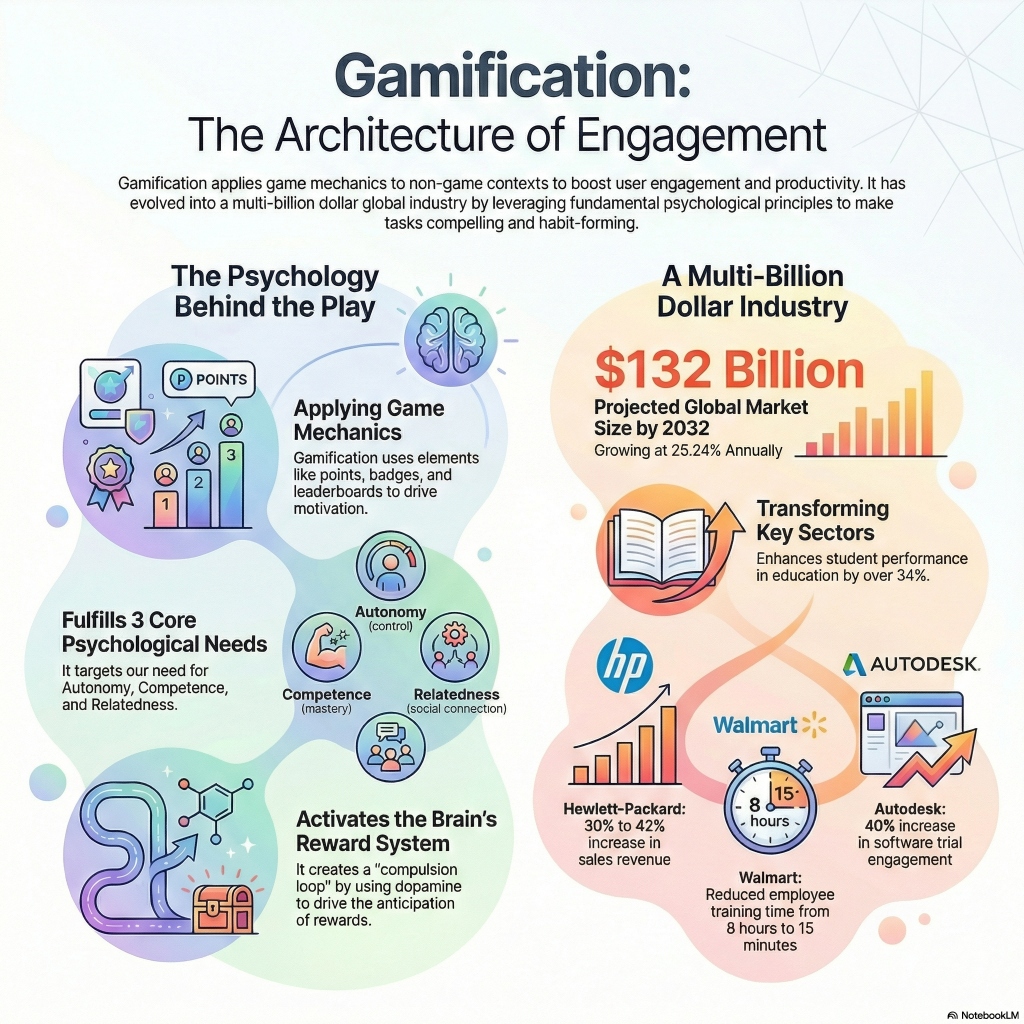
The Architecture of Engagement
The Architecture of Engagement: A Comprehensive Analysis of Gamification Theory, Mechanism, and Global Implementation
The phenomenon of gamification represents a fundamental shift in the design of human-computer interaction, evolving from a niche marketing strategy into a multi-billion-dollar global industry that reshapes how individuals learn, work, and manage their health. At its most formal level, gamification is defined as the application of game design elements and digital game mechanics to non-game contexts, aimed specifically at enhancing user engagement, experience, and productivity.[1, 2] This discipline prioritizes a human-focused design philosophy, acknowledging that participants in any system are governed by feelings, insecurities, and complex motivational drivers rather than mere functional requirements.[3] By optimizing for these emotional and psychological triggers, gamification creates immersive environments that transform mandatory tasks into voluntary, habit-forming experiences.
The Historical Genesis of Behavioral Incentivization
The roots of gamification extend far beyond the digital age, originating in late 19th-century retail strategies. In 1896, Sperry & Hutchinson launched S&H Green Stamps, a program that allowed customers to collect stamps with purchases from supermarkets and gas stations, which could later be redeemed for products ranging from linens to furniture.[4] This program established the foundational logic of a points-based reward system that incentivizes repetitive consumer behavior through tangible progression.[5]
By the early 20th century, the principles of gamification moved into social and character development. The founding of the Boy Scouts in 1908 and the Girl Scouts in 1912 introduced a sophisticated badge-based recognition system. These organizations awarded badges to members who demonstrated proficiency in specific skills or adhered to organizational principles, effectively utilizing visual markers of achievement to motivate long-term skill acquisition and social service.[4, 6, 7]
The mid-20th century saw the transition of game-like thinking into the professional world. In 1973, Charles Coonradt founded the Game of Work to address declining productivity in the United States. He hypothesized that the high engagement seen in sports and recreation was driven by shared goals and frequent feedback, suggesting these elements could solve the problem of employee disengagement.[5, 6] This period also witnessed the birth of social video games with the development of MUD1 (Multi-User Dungeon) in 1978 by Roy Trubshaw and Richard Bartle, which laid the groundwork for online social interaction within digital gaming environments.[6, 7]
| Year | Milestone Event | Significant Contributor | Contextual Impact |
|---|---|---|---|
| 1896 | S&H Green Stamps Launch | Sperry & Hutchinson | First major retail reward-for-purchase program [4] |
| 1908 | Boy Scouts Founded | Robert Baden-Powell | Introduction of badges for skills and character [6] |
| 1973 | The Game of Work | Charles Coonradt | Workplace productivity linked to game mechanics [5] |
| 1978 | MUD1 Development | Roy Trubshaw, Richard Bartle | First social, multi-user digital gaming environment [7] |
| 1981 | AAdvantage Program | American Airlines | Global standardization of frequent flier points [4] |
| 1981 | Malone Research Paper | Thomas W. Malone | Academic theory of intrinsically motivating instruction [5] |
| 1987 | McDonald’s Monopoly | McDonald’s | Breakthrough in mass-market gamified marketing [4] |
| 2002 | Coining “Gamification” | Nick Pelling | Formal naming of the industry and discipline [6] |
| 2010 | Industry Explosion | Bunchball/Badgeville | Market adoption and widespread venture capital [1] |
In 1981, two major events solidified the commercial and academic legitimacy of the field. American Airlines launched AAdvantage, the first major frequent flier program, which utilized the same rewards style used in modern loyalty ecosystems to encourage repetitive brand engagement.[4] Simultaneously, Thomas W. Malone published Toward a Theory of Intrinsically Motivating Instruction, which outlined how computer games could be used to stimulate engagement in education.[5, 7] The actual term “gamification” was not coined until 2002 by Nick Pelling, a British game designer who sought to describe the process of creating game-like user interfaces for commercial devices such as ATMs and vending machines.[5, 6] The term gained mainstream traction around 2010, following the success of platforms like Foursquare and the emergence of gamification-as-a-service providers such as Bunchball and Badgeville.[1]
Theoretical Foundations: Self-Determination and Motivation
The efficacy of gamification is fundamentally predicated on Self-Determination Theory (SDT), a broad framework for understanding human motivation developed by Edward Deci and Richard Ryan.[8, 9] SDT suggests that individuals possess an inherent tendency toward psychological growth and mastery, but this potential is only realized when three basic psychological needs are met: autonomy, competence, and relatedness.[8]
Autonomy refers to the need for a sense of initiative and ownership over one’s actions, supported by experiences of interest and value while undermined by external control.[8] Competence involves the feeling of mastery and the ability to grow, which is best satisfied in environments that provide optimal challenges and positive feedback.[8, 10] Relatedness concerns the sense of belonging and connection to others, facilitated by mutual respect and caring.[8] Gamified systems excel by providing affordances for these needs. For example, customizable avatars and branching learning paths satisfy autonomy; progress bars and levels demonstrate competence; and leaderboards or team challenges foster relatedness.[10, 11]
| Motivational State | Regulatory Mechanism | Relationship to Self | Performance Impact |
|---|---|---|---|
| Intrinsic Motivation | Interest, Enjoyment, Satisfaction | Fully Autonomous | Highest quality, sustained [8] |
| Integrated Regulation | Congruence with core values | Highly Autonomous | Sustainable, value-driven [9] |
| Identified Regulation | Endorsement of utility | Volitional | Goal-oriented [9] |
| Introjected Regulation | Ego-involvement, guilt/shame | Partially Internalized | Mixed, often creates anxiety [9] |
| External Regulation | Rewards and punishments | Controlled | Short-term, fragile [8] |
| Amotivation | Non-intentionality | Zero | No engagement [9] |
A critical distinction in SDT is the difference between intrinsic and extrinsic motivation. Intrinsic motivation involves pursuing an activity because it is inherently interesting or enjoyable.[12] Extrinsic motivation refers to performing a behavior for a separable outcome, such as a physical reward or to avoid social shame.[9] While gamification often utilizes extrinsic motivators like points and badges, the ultimate goal of sophisticated systems is to facilitate “internalization,” where extrinsic goals are transformed into autonomous, intrinsic drives.[8] Failure to balance these can lead to the “Overjustification Effect,” where the introduction of external rewards for an already interesting task results in a decrease in long-term intrinsic motivation once those rewards are removed.[13]
Neurobiological Foundations of the Reward Loop
The psychological effects of gamification are underpinned by specific neurobiological mechanisms, primarily the mesolimbic dopamine circuit.[14] Dopamine is the central neurotransmitter in the brain’s reward system, but its primary function is not the delivery of pleasure; rather, it drives “wanting” or incentive salience—the anticipation and seeking of a reward.[14, 15]
When a user engages with a gamified system, dopamine neurons respond to “reward prediction errors.” If a situation’s reward value is better than predicted, a phasic burst of dopamine is released, reinforcing the behavior.[16] If a reward is cued in advance, dopamine is released during the anticipation phase, compelling the user to take action.[14] This creates a “compulsion loop,” where the brain anticipates the next small win, whether it is completing a level, earning a badge, or maintaining a daily streak.[17]
The effectiveness of these loops is significantly enhanced by “Variable Reward Schedules.” Based on B.F. Skinner’s work on operant conditioning, variable-ratio schedules provide rewards after an unpredictable number of actions.[18, 19] Research indicates that uncertain rewards release more dopamine than predictable ones, explaining why mechanics like mystery boxes or randomized loot are so effective at maintaining high, steady rates of response.[11, 19]
Beyond dopamine, gamification engages other neurochemical systems:
- Oxytocin: Known as the “trust hormone,” oxytocin is released during cooperative missions, team rankings, and collaborative challenges. This hormone facilitates bonding and prosocial behavior within virtual and corporate communities.[17]
- Endorphins: These chemicals are responsible for the “liking” or the actual pleasurable impact of reward consumption, providing a sense of satisfaction and pain relief after a difficult task is mastered.[15]
- Hippocampus Activation: The integration of narrative and storytelling in gamification targets the hippocampus, making information more memorable and meaningful through emotional connection.[14]
These neurobiological processes contribute to the “Flow State,” a term coined by Mihaly Csikszentmihalyi to describe a psychological state of deep immersion where the challenge of a task is perfectly balanced with the user’s skill level.[14] In this state, distractions fall away, and the user experiences a high degree of focused productivity and satisfaction.[14, 20]
Structural Design Frameworks
To effectively implement these psychological and biological principles, several frameworks have been developed to guide designers through the complexities of gamification.
The MDA Framework: Mechanics, Dynamics, Aesthetics
The MDA framework, created by Robin Hunicke, Marc LeBlanc, and Robert Zubek, decomposes games into three interconnected components to bridge the gap between technical design and player experience.[21, 22]
- Mechanics: These are the foundational rules, data representations, and algorithms that govern the system. In an educational context, mechanics include point systems, levels, badges, and progress bars.[22, 23]
- Dynamics: This layer describes the runtime behavior that emerges when players interact with the mechanics. Dynamics include tactical positioning, exploration, and the social competition that arises from leaderboards.[23, 24]
- Aesthetics: This refers to the emotional responses evoked in the player. Designers strive for specific “kinds of fun,” such as discovery, challenge, fellowship, or self-expression.[22]
The framework highlights a crucial dichotomy: designers approach the system from the mechanics toward aesthetics, whereas players experience the aesthetics first and only indirectly discover the underlying mechanics.[24, 25]
The Octalysis Framework
Developed by Yu-kai Chou, the Octalysis Framework identifies eight core drives that motivate human behavior, represented as an octagon.[3, 26]
| Core Drive | Classification | Motivational Essence |
|---|---|---|
| Epic Meaning & Calling | White Hat / Right Brain | Feeling like part of something bigger [3, 26] |
| Development & Accomplishment | White Hat / Left Brain | Internal drive to grow and master skills [3, 26] |
| Empowerment of Creativity | White Hat / Right Brain | Joy of creating and receiving feedback [3, 26] |
| Ownership & Possession | Left Brain | Motivation to own or control something [3, 26] |
| Social Influence & Relatedness | Right Brain | Need for human interaction and acceptance [3, 26] |
| Scarcity & Impatience | Black Hat / Left Brain | Desiring things because they are unavailable [3, 26] |
| Unpredictability & Curiosity | Black Hat / Right Brain | Excitement of surprise and the unknown [3, 26] |
| Loss & Avoidance | Black Hat / Left Brain | Motivation to avoid negative consequences [3, 26] |
Chou distinguishes between “White Hat” motivators (top of the octagon), which make users feel powerful and satisfied, and “Black Hat” motivators (bottom), which utilize urgency, obsession, and fear. While Black Hat motivators are highly effective at driving immediate action, they often lead to long-term burnout and negative associations with the system.[3, 27]
The Hook Model
Nir Eyal’s Hook Model provides a four-stage process for building habit-forming products by connecting a user’s problem with a solution with enough frequency to form a habit.[28]
- Trigger: An external or internal prompt that initiates action. External triggers include notifications or ads; internal triggers are emotional pain points or routines.[29, 30]
- Action: The behavior performed in anticipation of a reward. It must be simple and requires both motivation and ability.[28, 29]
- Variable Reward: The satisfaction of the trigger through three types of rewards: of the tribe (social validation), of the hunt (information/deals), or of the self (mastery/completion).[28, 31]
- Investment: The user puts time, data, or effort back into the product, which increases the value of the experience and primes the next trigger.[28, 29]
Behavioral Profiling: Player Typologies
A primary reason for the failure of gamification projects—estimated at 80% by Gartner due to poor design—is the failure to account for diverse player personalities.[32, 33] Richard Bartle’s Taxonomy of Player Types, originally developed for MMORPGs, categorizes players into four main types.[34, 35]
- Achievers (Diamonds): These players are focused on concrete measurements of success, such as points, levels, and badges. They seek to “beat” the game and demonstrate their elite status to others.[34, 36]
- Explorers (Spades): Motivated by discovery, Explorers enjoy uncovering the mechanics of the game world, finding hidden “Easter Eggs,” and immersing themselves in lore. They prioritize the journey over the destination.[34, 37]
- Socializers (Hearts): Making up nearly 80% of players, Socializers derive fun from interacting with other players. They value collaboration, guilds, and community-building more than the game’s primary objectives.[36, 37]
- Killers (Clubs): A small but influential group (less than 1%), Killers thrive on competition and the thrill of outsmarting or overpowering opponents. They want to see others lose as they win.[35, 37]
Strategic gamification involves “layering” mechanics to appeal to these different groups simultaneously. For instance, a sales gamification platform might include leaderboards for Killers, milestones for Achievers, team challenges for Socializers, and hidden rewards for Explorers.[36]
Sector-Specific Implementations and Case Analysis
Corporate Learning and Workforce Management
Gamification has become a mainstream strategy in Human Resources (HR) and Learning & Development (L&D), with 70% of Global 2000 companies employing it in some form.[38] The primary goal is to combat the pervasive issue of employee disengagement, which affects nearly 68% of the global workforce.[33]
| Organization | Application | Reported Outcome |
|---|---|---|
| Autodesk | Software Trial Gamification | 40% increase in trial engagement; 15% higher conversion [39, 40] |
| Hewlett-Packard | Sales Force Gamification | 30% to 42% increase in revenue over two months [40] |
| Tyson Foods | VR Safety Training | 20% year-over-year reduction in workplace injuries [40] |
| Walmart | VR Training for Pickup Towers | Training time reduced from 8 hours to 15 minutes [41] |
| Extraco Bank | Customer Acquisition | 700% increase in new customer acquisitions [40] |
| Deloitte | Leadership Training | 30% rise in adoption of gamified training programs [40] |
In onboarding, gamified modules cut the average time to productivity by 30% compared to traditional orientation methods.[42] Sales teams, which are often composed of high-performance “Killers” and “Achievers,” retain messaging 25% better when training is delivered via scenario-based simulations.[42] Mature learning teams measure ROI by tracking behavior changes, such as reduced compliance errors or faster sales ramp-ups, rather than just completion rates.[42]
Healthcare and Patient Engagement
The healthcare gamification market is projected to reach $10.8 billion by 2032, driven by the need to manage chronic lifestyle-related diseases.[43] Gamification empowers patients to take an active role in their own health journeys by fostering autonomy and competence.[44, 45]
- Chronic Disease Management: Apps like Kaia Health and MySugr reward users for adhering to daily routines and self-monitoring. These elements make the “tedious” aspects of managing diabetes or cardiovascular health more goal-oriented and manageable.[43, 44]
- Mental Health: Gamification serves as a coping mechanism for stress and anxiety. Mood tracking streaks and science-backed mini-games provide positive reinforcement, which is particularly beneficial for individuals experiencing the reward-processing deficits of depression.[43]
- Physical Therapy: Platforms like Augment Therapy combine motion recognition and story-driven missions to transform rehabilitation exercises into quests. This improves adherence to home-based treatment, which is historically a major failure point in physical therapy.[43]
Education and Higher Learning
Challenge-based gamification has been linked to a 34.75% enhancement in student performance.[39] Platforms like Duolingo use streak counters and XP rewards to achieve retention rates as high as 55%, with users completing 15 lessons per week compared to just 3 in traditional apps.[46] Game-based learning is increasingly adopted in medical and nursing education to advance clinical reasoning and professional competencies.[47] For instance, a study by Brigham and Women’s Hospital found that clinicians who participated in online gaming controlled their patients’ blood pressure in a shorter time than non-gamers.[44]
The Global Gamification Market: Dynamics and Projections
The gamification industry is undergoing a period of rapid acceleration, with the market valued at approximately 132 billion by 2032.[31]
| Metric | 2019/2023 Value | 2025/2026 Projection | 2030-2035 Forecast | CAGR |
|---|---|---|---|---|
| Global Market Size | $16.1B (2023) | $29.11B (2025) | $112.3B (2031) | 25.24% [48] |
| Education Segment | $2.95B (2025) | — | $40.5B (2035) | 27.4% [31] |
| Cloud Deployment | 67.6% Share | — | — | 26.9% [48] |
| Asia Pacific Growth | — | — | — | 28.6% [48] |
| Healthcare Market | $4.4B (2024) | — | $10.8B (2032) | — [43] |
Key drivers for this growth include the surge in cloud-first digital workplace roll-outs and the demand for customer engagement in the retail sector, which accounted for 28.5% of total revenue in 2023.[40, 48] Large enterprises currently hold 57.02% of the market share, but Small and Medium Enterprises (SMEs) are the fastest-growing segment with a CAGR of 27.65%.[48] Geographically, while North America currently holds the largest share, the Asia Pacific region is expanding the fastest due to mobile-first enterprise strategies.[40, 48]
Technological Frontiers: AI, XR, and Spatial Computing
The transition toward spatial computing and AI-integrated systems represents the “Android moment” for gamification in 2026.[41]
Artificial Intelligence and Personalized Engagement
AI is transforming gamified marketing and training by enabling hyper-personalized experiences. Each user no longer follows a generic path but a narrative drafted specifically for their skill level and preferences.[49]
- LLM-Driven NPCs: Using Large Language Models like Llama 3.2 3B Instruct, developers are creating “Smart NPCs” that can engage in open-ended, dialogue-driven interactions.[50, 51] These characters have contextual awareness and can remember a player’s previous choices, fostering a deeper sense of immersion in training simulations.[50, 51]
- Adaptive Scaffolding: Systems like SRLAgent use real-time AI support to foster Self-Regulated Learning (SRL) skills, providing feedback and task management within interactive game-based environments.[52]
- AI-XR Convergence: Generative AI allows spatial computing devices to “see” and “understand” environments, enabling proactive interactions and passive assistance in work and collaboration.[41]
Spatial Computing (AR/VR/XR)
By 2026, Extended Reality (XR) is no longer a niche market for gaming but a fundamental pillar of business. Spatial AR is turning physical locations into interactive arcade environments—Nike’s “Victory Mode Paris” turned the sky into an arcade during the Olympics, reaching over 90% of French youth.[41, 53]
- Hardware Evolution: Advances in MicroLED and resin diffractive waveguides have allowed for AR glasses weighing as little as 38 grams, making them viable for long-term daily wear.[41]
- Digital Humans: AI-driven digital avatars allow for 24/7 immersive customer service and personalized training videos, reducing content creation time by 50%.[53, 54]
- Spatial Social Networks: These networks allow for virtual events and 3D character interactions with a sense of “presence” that traditional video calls cannot replicate.[41]
Ethical Considerations and the “Playbor” Debate
The rise of gamification has triggered significant moral debates, particularly concerning the potential for exploitation and the use of “dark patterns”.[55, 56]
The Charge of Exploitation and “Playbor”
Critics like Ian Bogost have argued that gamification is “exploitationware,” a tool for companies to dupe individuals into performing free or low-cost labor—a concept known as “Playbor”.[56, 57] This argument suggests that when companies replace financial incentives with digital points and badges, they are siphoning the surplus value generated by workers who are motivated only by the “fun” of the task.[57, 58] However, academic analysis often finds no clear grounds for labeling the gamification of labor as wrongfully exploitative unless there is a severe imbalance of power or the presence of deception.[56, 58]
Deceptive Design and Dark Patterns
Dark patterns are manipulative design strategies that exploit cognitive biases to coerce users into unwanted behaviors against their best interests.[55, 59]
| Dark Pattern Category | Description and Example | Psychological Driver |
|---|---|---|
| Monetary | ”Pay to Skip” – charging to avoid “grinding” [60] | Frustration and impatience [55] |
| Temporal | ”Playing by Appointment” – required logins [60] | Scarcity and fear of missing out [59] |
| Social | ”Privacy Zuckering” – tricky data sharing [61] | Trust and social compliance [61] |
| Behavioral | ”Roach Motel” – difficult to cancel [61] | Cognitive inertia and barriers [62] |
| Psychological | ”Bait and Switch” – unexpected outcomes [61] | Confusion and sunk cost [61] |
Ethical concerns range from financial harm to digital addiction. Research indicates that many dark patterns emerge from industry pressures rather than overt malicious intent, but they nonetheless damage user autonomy and trust.[55, 62] The “Manipulation Matrix” is proposed as an ethical tool, asking whether a product helps users achieve a goal they already have, or whether it creates a new, potentially harmful desire.[29]
Failed Implementations and Design Hazards
Despite the growth of the industry, many projects fail to meet business objectives. A case analysis of seven failed implementations—including Microsoft Ribbon Hero, Google News Badges, and Yahoo Answers Points—identified three core mistakes:
- Improper Design of Mechanics: Structural flaws in how game elements are executed.[32]
- Ignoring Player Personalities: A one-size-fits-all approach that fails to motivate different types of users.[32]
- Lack of Real-World Alignment: Failure to connect gamified content with the player’s actual goals.[32]
Furthermore, “Pointsification”—the shallow implementation of points, badges, and leaderboards without deeper design—is cited as a primary reason for the high failure rate of enterprise projects.[2, 33] Organizations that merely “slap on” game elements without considering the underlying psychology often see only short-term engagement spikes followed by rapid disinterest.[33]
Strategic Conclusion: The Future of the Human Experience
Gamification in 2026 has evolved into a sophisticated, multi-disciplinary field at the intersection of psychology, neurobiology, and advanced computing. Its success is no longer judged by the presence of a leaderboard but by the depth of the “Engagement Loop” and the fulfillment of the user’s basic psychological needs. As AI and spatial computing continue to merge, the boundary between work, play, and learning will further dissolve, creating “Playbor” environments that are increasingly seamless.
For organizations, the primary challenge remains the ethical and effective design of these systems. Moving beyond superficial mechanics toward “White Hat” motivators—Epic Meaning, Empowerment of Creativity, and Relatedness—will be essential for creating sustainable, long-term engagement. As the global market scales toward a valuation exceeding $100 billion, gamification will stand not as a gimmick, but as the primary architectural framework for the digital human experience. Sustained success will require a commitment to user-centered design, the avoidance of deceptive patterns, and the strategic integration of emerging technologies like AI and XR to provide truly meaningful, personalized, and autonomous experiences.
- Gamification - Wikipedia
- Gamification - Coursera
- Octalysis: The Complete Gamification Framework (8 Core Drives …
- The History of Gamification - CataBoom
- Who started gamification? - Spinify
- The History of Gamification: From the Beginning to Right Now - Growth Engineering
- A Quick History of Gamification Vol.1 - eVULX
- Intrinsic and extrinsic motivation from a self-determination theory …
- Harnessing intrinsic and extrinsic motivation through gamification - Drimify
- The psychological underpinnings of gamified learning - Intuition
- The Psychology of Gamified Education - Ludus.hu
- Impacts of gamification on intrinsic motivation - NTNU
- Align the Game to Your Aim: Considering Gamification through the Lens of Self-Determination Theory - ICE Blog
- The Neuroscience of Gamification: Unlocking True Learner Engagement
- Dopamine Loops and Player Retention: A Study on Reinforcement in Free-to-Play Games
- Dopamine in motivational control: rewarding, aversive, and alerting - PMC - PubMed Central
- How to apply Neuroscience to responsible gamification in UX Design - Medium
- Variable-Ratio Schedule Characteristics and Examples - Verywell Mind
- Rewards: reinforce engagement - Learning Loop
- Gamification Design Frameworks Explained - How to Hook Users?
- Gamification Design Frameworks course lesson - Uxcel
- MDA: A Formal Approach to Game Design and Game Research - Northwestern University
- MDA FrameworkGame Design Meets Microlearning: A Deep Dive …
- MDA Game Design Framework: Meaning, Model, Examples
- MDA Framework – Game Design Toolkit
- Top Gamification Frameworks Explained: How to Choose the Right One - Diversido
- Octalysis Framework: Learning Motivation via Gamification - Masterplan
- What is the Hook Model ? | Definition & Overview | ProdPad
- Understanding the Hook Model: How to Create Habit-Forming Products - Dovetail
- How to Build Habit-Forming Products - Nir Eyal - UI Talks
- Gamification Market Analysis: Key Trends and Insights for 2026 - CrustLab
- Failed Gamification Implementations in Practice: Case Analysis and …
- Do 80% of all gamification projects fail? Gartner is right - Centrical
- Bartle taxonomy of player types - Wikipedia
- Complete Guide to Bartle Taxonomy Player Types - Osiz Technologies
- Gamification & Bartle Player Types in Field Sales - SalesRabbit
- Bartle’s Player Types for Gamification | IxDF - The Interaction Design Foundation
- Corporate eLearning Statistics (2025): Key Trends & ROI Data | Continu
- Gamification Success Stories: A Tale of EdTech Transformation - TekRevol
- 26 Reliable gamification statistics that impact business in 2026 - Open Loyalty
- The Augmented Reality and Virtual Reality Industry 2026
- Gamified Corporate Training 2025: Examples & Key Strategies - Disprz
- Gamification in Healthcare: Use Cases, Techniques, and Challenges | Orangesoft
- Gamification in Healthcare: Boosting Patient Engagement & Outcomes | Stellarix
- Case Study: The Onset of Gamification in Healthcare
- Top Gamification Apps to Watch in 2025 - PUG Interactive
- Emerging trends in gamification for clinical reasoning education: a scoping review - PMC
- Gamification Market - Industry Trends, Size 2031 Report - Mordor Intelligence
- Gamification in Marketing: Trends for 2025 - Rhapsody Media
- A Quest for Information: Enhancing Game-Based Learning with LLM-Driven NPCs
- Part II - The Role of AI in Evolving Game Ecosystems and Player Dynamics
- SRLAgent: Enhancing Self-Regulated Learning Skills through Gamification and LLM Assistance - arXiv
- XR Trends 2026: The Future of AR and VR for Business - YORD Studio
- Enhancing Corporate Training with AI-Driven Game and Digital Human Solutions
- Dark Patterns in Games: An Empirical Study of Their Harmfulness - SciTePress
- (PDF) Gamification of Labor and the Charge of Exploitation - ResearchGate
- Gamification, Playbor & Exploitation - Cyborgology - The Society Pages
- Gamification of Labor and the Charge of Exploitation
- A Scenario Analysis of Ethical Issues in Dark Patterns and Their Research - arXiv
- Level Up or Game Over: Exploring How Dark Patterns Shape Mobile Games - arXiv
- (PDF) The Dark (Patterns) Side of UX Design - ResearchGate
- Dark Patterns in Games: An Empirical Study of Their Harmfulness - SciTePress