The Neurobiology of Compulsion
The Neurobiology of Compulsion: A Comprehensive Analysis of the D.O.S.E. Framework in Interactive Systems
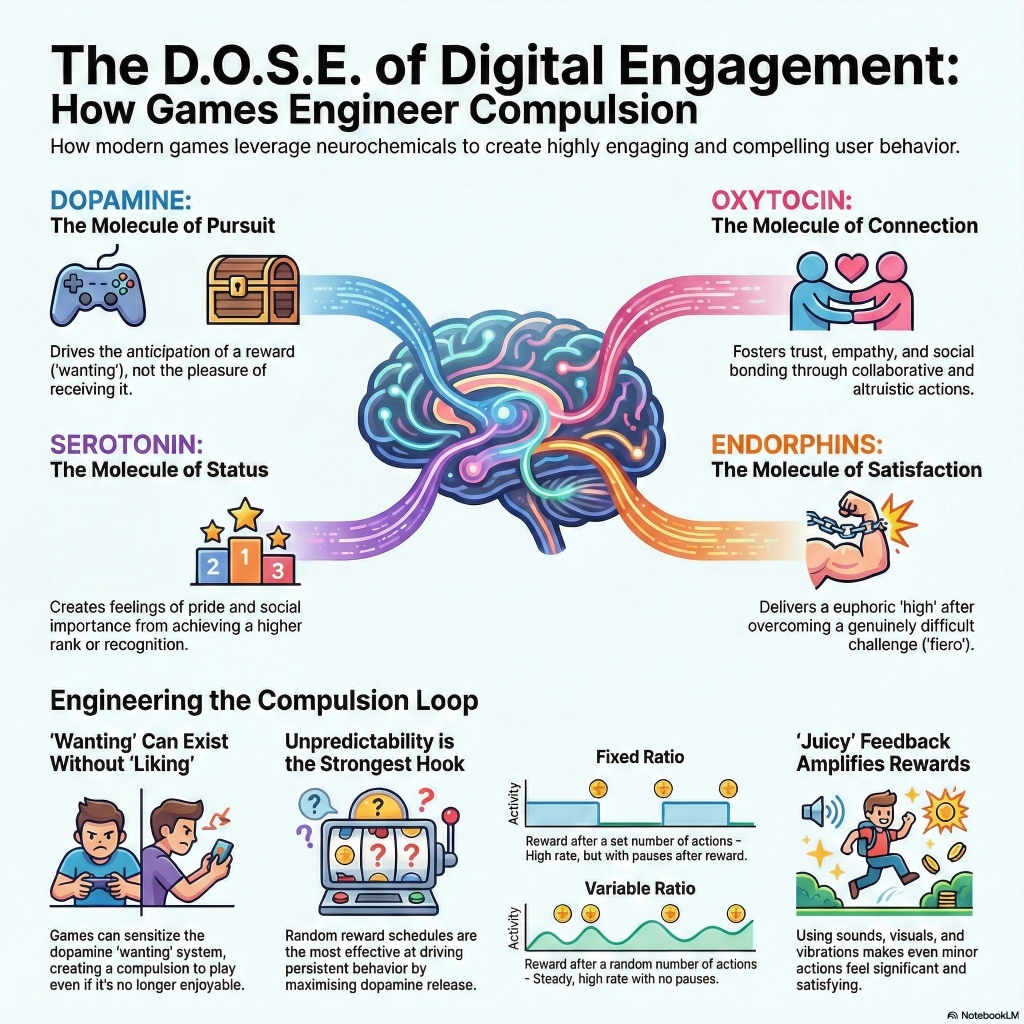
The architecture of modern digital engagement is increasingly predicated on a sophisticated understanding of the human nervous system. While early game design relied on intuitive notions of “fun” and “challenge,” contemporary systems are engineered to interface directly with the mesocorticolimbic reward circuitry. Central to this engineering is the D.O.S.E. framework—an acronym for Dopamine, Oxytocin, Serotonin, and Endorphins—which categorizes the primary neurochemical drivers of human motivation, social bonding, status-seeking, and satisfaction.[1, 2] These chemicals are the biological instruments of survival, evolved to reward behaviors that promote resource acquisition, social cohesion, and physical resilience.[1, 3] In the context of interactive media, particularly tapping and idle games, these pathways are leveraged to create “compulsion loops” that maintain high levels of user engagement through the precise calibration of neurochemical triggers.[4, 5]
The Dopaminergic System: The Molecule of Incentive Salience
Dopamine is frequently mischaracterized in popular discourse as the “pleasure molecule.” However, rigorous neurobiological research differentiates between the hedonic impact of a reward and the motivational drive to obtain it.[1, 6, 7] Dopamine is the primary neurotransmitter of incentive salience—the “wanting” system.[6, 8, 9] It functions as a signal of anticipation and pursuit rather than a direct mediator of sensory pleasure.[1, 10] This distinction is critical for understanding why players may feel a compulsive urge to engage with a game even when the actual experience of playing has ceased to be enjoyable.[6, 8]
Reward Prediction Error and Phasic Signaling
The most potent trigger for dopamine release is not the reward itself, but the Reward Prediction Error (RPE). This neurobiological signal represents the variance between the expected value of an outcome and the actual value received.[11, 12, 13] When an outcome exceeds expectations, a positive RPE occurs, resulting in a phasic surge of dopamine.[12, 14] Conversely, if a reward is omitted or is less than anticipated, a negative RPE causes a depression in dopamine activity.[12, 14]
The dopamine response is observed to follow a two-component temporal pattern. The initial component is a brief, unselective increase in activity that detects any potential stimulus based on its physical salience or novelty.[12] This “header” signal prepares the brain for action before the specific value of the stimulus is even known. The second, more stable component evolves into a coding of the subjective reward value and utility.[12] This mechanism allows the brain to optimize for both speed (initial detection) and accuracy (subsequent valuation), a feature that is highly exploitable in fast-paced tapping games where rapid feedback is constant.[12, 15]
The mathematical representation of this learning process is often modeled through the Rescorla-Wagner equation, which describes how predictions are updated based on errors:
In this model, represents the change in the associative strength (or prediction) at time t, is the learning rate, is the actual reward received, and is the total predicted value based on previous experience. The term is the prediction error, which directly correlates with phasic dopamine activity.[11, 12, 13]
| Dopamine Component | Duration | Primary Function | Behavioral Response |
|---|---|---|---|
| Initial Component | Sub-second (tens of ms) | Salience and novelty detection | Alertness, orientation to stimulus |
| Main Component | Phasic (seconds) | Valuation and utility coding | Pursuit, reinforcement of behavior |
| Tonic Level | Continuous | Baseline motivation and arousal | General activity levels, persistence |
The “Wanting” vs. “Liking” Dissociation
A profound insight into the neurochemistry of engagement is the dissociation between “wanting” (incentive salience) and “liking” (hedonic impact).[6, 7, 8] While rewards that are “liked” are typically also “wanted,” these two systems are neurobiologically separable. “Wanting” is mediated by mesocorticolimbic dopamine projections from the midbrain to the nucleus accumbens, while “liking” is mediated by “hedonic hotspots” in the nucleus accumbens and ventral pallidum that utilize mu-opioids and endocannabinoids.[6, 8, 9]
This dissociation explains the mechanism of addiction and extreme compulsion. Repeated exposure to highly salient cues—such as the flashing lights and numerical increases in a tapping game—can sensitize the “wanting” system without changing the “liking” system.[6, 8] This results in “irrationally strong motivation urges” where a player compulsively pursues a goal they no longer expect to find pleasurable or even remember liking in the past.[6, 8] In tapping games, this is manifested as the “one more click” phenomenon, where the anticipation of the next increment (dopamine) far outweighs the actual satisfaction of achieving it (endorphins).[4, 16]
Reinforcement Schedules: The Engineering of Persistence
The efficacy of the dopaminergic system in maintaining engagement is dependent on the schedule of reinforcement. Borrowing from Skinner’s operant conditioning, game designers implement various schedules to dictate when a player action (e.g., a tap) results in a reward (e.g., currency, loot, or a visual flourish).[5, 17, 18]
Variable Ratio Schedules and the Slot Machine Effect
Among all reinforcement patterns, the Variable Ratio (VR) schedule is the most effective at driving high rates of steady, persistent behavior.[5, 17, 19] Under a VR schedule, a reward is delivered after an unpredictable number of responses.[17, 18] This unpredictability maximizes dopamine release because every single action carries the potential for a “positive reward prediction error”.[4, 5, 14]
In the context of a simple tapping game, the VR schedule is vital for maintaining a compulsion loop.[4] If rewards were predictable (Fixed Ratio), players would likely exhibit a “post-reinforcement pause,” a brief halt in activity after receiving a reward because they know the next one is several actions away.[5, 18] By contrast, the VR schedule ensures that the player remains in a state of constant anticipation, as the next tap could always be the one that triggers a “jackpot” or a rare item drop, much like the mechanics of a slot machine.[4, 17]
| Schedule Type | Definition | Player Response Pattern | Resistance to Extinction |
|---|---|---|---|
| Fixed Ratio (FR) | Reward after set number of actions | High rate with post-reward pauses | Low (behavior stops if reward ends) |
| Variable Ratio (VR) | Reward after random number of actions | Steady, high rate; no pauses | Very High (behavior persists without reward) |
| Fixed Interval (FI) | Reward after set amount of time | Scalloped (rate increases as time nears) | Low |
| Variable Interval (VI) | Reward after random amount of time | Slow, steady rate | High |
Layering and Complexity in Compulsion Loops
Advanced game systems rarely rely on a single schedule. Instead, they layer schedules to create a complex neurochemical landscape. For example, a game may use a Fixed Interval (FI) schedule for daily login bonuses to establish a habit, while employing a Variable Ratio (VR) schedule for in-game loot drops to drive session length.[5, 19] This combination ensures that the player is motivated both to return daily (reducing churn) and to engage deeply during each session (increasing monetization opportunities).[4, 19]
The compulsion loop is further strengthened by the “near-miss” phenomenon. In a VR system, a result that is “close” to a win (e.g., two out of three matching symbols) triggers a similar dopaminergic surge to an actual win because the brain interprets it as a signal that a reward is imminent.[9] This encourages continued play despite the lack of a tangible outcome, effectively exploiting the brain’s predictive mechanisms.[9, 20]
Endorphins: The Neurochemistry of Satisfaction and “Fiero”
Endorphins, a contraction of “endogenous morphines,” are the body’s natural pain relievers and mediators of the “liking” system.[3, 6, 21] While dopamine drives the pursuit, endorphins provide the satisfaction or “natural high” once a task is successfully completed.[3, 22] They are released in response to physical exertion, stress, and the achievement of difficult challenges.[21, 22, 23]
The Mechanics of “Fiero” and Flow
In game design, the feeling of “fiero”—the Italian word for intense pride after succeeding against great adversity—is the primary emotional state associated with endorphin release.[15, 22, 23, 24] To trigger this response, a game must present “worthy challenges” that require genuine effort or skill.[3, 22] If a task is too easy, the resulting victory is hollow and fails to trigger an endorphin hit; if it is too difficult, it leads to frustration and cortisol release.[3, 25]
For a tapping game, the challenge often lies in the volume of effort (the “grind”) or the optimization of clicking speed.[4, 15] The endorphin release acts as a “second wind,” reducing the perceived fatigue of the repetitive action and providing a sense of euphoria that reinforces the behavior.[22] This cycle of effort followed by a “hit” of satisfaction is what keeps players returning to a game even after the novelty has worn off.[15, 24]
The Relationship Between Flow and Endorphins
Flow is a state of extreme engagement where the player’s skills perfectly match the challenge presented.[15, 26, 27] During flow, the brain is highly efficient, and the constant feedback of success triggers a reliable supply of both dopamine (anticipation of the next move) and endorphins (satisfaction of the current move).[15, 26] However, flow is a temporary state that eventually depletes physical and mental resources.[26] Once a player masters a game—as seen in the historical account of a player reaching the maximum score in Breakout—the source of flow and fiero is exhausted, often leading to the sudden cessation of the obsession.[15, 26]
Oxytocin: Social Bonding and Collaborative Engagement
Oxytocin is the neuropeptide responsible for social cognition, trust, and pair bonding.[1, 10, 28] Often referred to as the “love hormone” or “trust molecule,” it facilitates prosocial behaviors by reducing social anxiety and enhancing empathy.[1, 28] In digital environments, oxytocin is triggered through collaborative play, recognition, and the creation of a sense of belonging.[10, 22]
Triggers of Oxytocin in Digital Contexts
Research by Paul J. Zak suggests that social interactions, even those mediated by technology, can evoke significant oxytocin release.[10, 22] For example, using social networks to express gratitude or participate in community-driven tasks can trigger reactions similar to those found in real-world social bonding.[10, 22, 29]
In game mechanics, oxytocin is boosted through several specific features:
- Collaborative Missions: Team-based play requires coordination and synchrony, which have been shown to evoke endogenous oxytocin release.[10, 30]
- Gifting and Altruism: Systems that allow players to give items or currency to others selflessly foster trust and reciprocity, which are fundamental oxytocin-driven behaviors.[22, 31, 32]
- Narrative Empathy: Engaging with a strong story where the player feels empathy for characters can trigger oxytocin, making the virtual experience feel emotionally “real”.[10, 22]
| Social Mechanic | Neurochemical Effect | Behavioral Result |
|---|---|---|
| Team Rankings | Oxytocin / Serotonin | Group cohesion, competitive drive |
| In-app Chat / Social Feeds | Oxytocin | Reduced isolation, brand loyalty |
| Gifting / Trading | Oxytocin | Mutual trust, reciprocity |
| Shared Story / Narrative | Oxytocin | Emotional resonance, empathy |
Synchrony and the Social Flow
Social synchrony—the temporal concordance of behavioral or physiological processes among individuals—is a powerful driver of oxytocin.[30] When players coordinate their actions in real-time (e.g., a “raid” in an MMO or a coordinated tap in a group challenge), the resulting synchrony enhances emotional expressiveness and cooperation.[30, 33] Studies indicate that “social flow” (performing a task together) is significantly more enjoyable and rewarding than solitary flow, likely due to the additional “hit” of oxytocin alongside dopamine and endorphins.[33]
Serotonin: Status, Pride, and the Hierarchy of Achievement
Serotonin is the neurochemical associated with well-being, mood regulation, and social status.[1, 2, 22, 25] In the brain, serotonin levels correlate with an individual’s sense of social importance and confidence.[1, 25] High levels are linked to lower rejection sensitivity, allowing individuals to place themselves in competitive situations that can further increase their self-esteem.[1]
The Pursuit of Social Dominance
The human brain is evolutionarily wired to seek social dominance and status, as these factors were historically linked to reproductive success and resource access.[25] When an individual perceives themselves as having achieved higher status—such as through a leaderboard ranking or a prestigious title—the brain rewards them with serotonin.[25, 34] However, serotonin is quickly metabolized, creating a “relentless” need for another moment of social dominance to maintain the good feeling.[25]
In game design, status games are implemented through:
- Leaderboards: These provide a visible hierarchy where players can compare their skills and progress against others.[34]
- Badges and Trophies: These serve as permanent records of achievement, allowing players to reflect on past successes and feel a sense of pride and “worthiness”.[5, 22, 35]
- Power Progression: The transition from a weak “newbie” to a powerful high-level player provides a tangible sense of growth and social dominance within the game’s ecosystem.[35]
The Conflict of Status and Stress
While status-seeking drives engagement, it is often accompanied by cortisol—the primary stress hormone.[25] Threats to a player’s status (e.g., being “dethroned” on a leaderboard) trigger cortisol, leading to feelings of anxiety and frustration.[25, 34] This competition can lead to negative social outcomes, such as envy, resentment, and even toxic behavior like “trash talking” or cheating, as players struggle to regain their serotonin-driven sense of importance.[34]
Sensory Integration and “Juicy” Feedback Loops
The neurochemical response to game mechanics is significantly amplified by the sensory environment. The brain does not process sensory cues in isolation; it integrates visual, auditory, and tactile information to construct a single, cohesive experience of reality.[9, 20] This phenomenon, known as multisensory integration, is the foundation of “juicy” game design.[9, 20, 36]
Haptic Feedback and the Physiology of Touch
Tactile feedback is one of the most fundamental sensory channels, connecting the virtual experience directly to the player’s physical body.[9, 20] Modern haptic devices use varying frequencies and rhythms to mimic real-world interactions—low-frequency vibrations for heavy impacts and high-frequency feedback for textures.[9, 20]
Neuroscience shows that physical sensations directly trigger the limbic system, the part of the brain responsible for emotion and memory.[20] A well-timed vibration synchronized with a visual reward (e.g., a “pop” animation when tapping a coin) strengthens the illusion of realism and intensifies the dopaminergic response.[9, 20] This is because the brain is predictive; it anticipates a physical sensation based on visual context, and meeting that expectation provides a sense of psychological realism and satisfaction.[20]
| Sensory Channel | Cue Example | Neurochemical Link | Emotional Response |
|---|---|---|---|
| Visual | Flashing icons, bright colors | Dopamine (RPE) | Excitement, Alertness |
| Auditory | Chimes, celebratory music | Dopamine / Endorphins | Satisfaction, Joy |
| Tactile | Controller rumble, haptics | Endorphins (Limbic system) | Realism, “Fiero”, Empathy |
The Power of “Juicy” Design
“Juicy” design refers to the use of excessive feedback to celebrate small player actions.[9, 36] In a tapping game, a single click might result in a burst of particles, a satisfying “ding” sound, a brief screen shake, and a haptic pulse.[5, 9] These cues serve as “conditioned stimuli” that trigger dopamine release through anticipation alone.[6, 10] By amplifying the sensory output, designers ensure that even the most mundane actions feel rewarding, effectively maintaining the compulsion loop during the periods between “big” rewards.[5, 9, 15]
The Pathology of Compulsion: Addiction and Neurochemical Burnout
The extreme effectiveness of the D.O.S.E. framework carries significant risks for behavioral health. When game systems are designed specifically to maximize neurochemical release, they can mirror the addictive properties of drugs or gambling.[4, 5, 14]
Dopamine Overload and Habituation
Continuous stimulation of the reward system through high-frequency rewards (e.g., constant tapping with instant feedback) can lead to dopamine receptor downregulation.[2, 6] The brain becomes desensitized to the “happy chemicals,” requiring more intense stimuli to achieve the same level of satisfaction.[2, 25] This state of “dopamine overload” is characterized by a lack of focus, increased dependency on high-stimulus digital media, and a diminished ability to experience pleasure in real-world activities.[2, 6]
Furthermore, if a player is constantly in a state of high arousal (driven by dopamine and cortisol from status competition), they may experience burnout.[26, 27, 37] The body cannot sustain the high-energy state of flow indefinitely, and eventually, the resources needed to process these neurochemical signals are exhausted.[26]
Ethical Design and Responsible Gamification
To mitigate these risks, responsible game designers are increasingly looking at “White Hat” gamification strategies—mechanics that focus on meaning, mastery, and social connection rather than just fear of loss or compulsive clicking.[10, 38] Techniques such as:
- Transparency: Clearly communicating reward probabilities (e.g., gacha drop rates) to manage player expectations and reduce the “gambling” effect.[5, 18]
- Cool-down Periods: Implementing natural breaks or limiting artificial scarcity to prevent overstimulation and allow for neurochemical recovery.[5, 10, 27]
- Oxytocin-Driven Connection: Shifting focus from individual status (Serotonin/Cortisol) to genuine community building (Oxytocin), which promotes long-term satisfaction rather than short-term compulsion.[10, 27, 37]
Strategic Synthesis and Future Trajectories
The neurochemical reward system is the engine of engagement in interactive media. By understanding the specific roles of Dopamine (pursuit), Oxytocin (connection), Serotonin (status), and Endorphins (satisfaction), designers can create loops that are not only effective but also emotionally resonant.
The Evolution of the Tapping Game
In a simple tapping game, the compulsion loop is optimized by:
- Dopamine: Using Variable Ratio schedules to ensure the next tap always holds potential value.[4, 17]
- Endorphins: Implementing “juicy” feedback and increasing difficulty to provide a sense of fiero and satisfaction.[9, 22]
- Serotonin: Integrating global leaderboards and progress badges to provide a sense of status and growth.[22, 34]
- Oxytocin: Adding asynchronous social features like gifting to foster community trust.[22, 31]
Neuroadaptive Systems and the Horizon of Play
Looking forward, the boundary between the player’s nervous system and the game will likely continue to blur.[20] Future “neuroadaptive” games may use biometric sensors to monitor stress levels (cortisol) and engagement levels (dopamine), automatically adjusting the difficulty or reward schedule to maintain a perfect state of flow.[20, 36] By tailoring the D.O.S.E. triggers to the individual’s physiological state, these systems could provide highly personalized experiences that maximize both engagement and emotional well-being.[20, 27]
Ultimately, the goal of neurochemical game design is to move beyond mere compulsion and toward “happiness engines”—systems that satisfy the human need for progress, connection, and mastery.[26] When the science of the brain is combined with the art of design, digital experiences can become a powerful tool for individual fulfillment and social cohesion.[2, 3, 26]
- D.O.S.E. : The brain’s happy chemicals, explained. - Khiron Clinics
- DOSE Lab - Unlock the secret powers of your brain chemicals
- A Cognitive Framework for Game Based Learning - isee systems
- Compulsion loop - Wikipedia
- Skinner Box Mechanics and Variable Reward Systems in Digital …
- From prediction error to incentive salience: mesolimbic computation …
- Social ‘wanting’ dysfunction in autism: neurobiological underpinnings and treatment implications - PMC
- Roles of “Wanting” and “Liking” in Motivating Behavior: Gambling, Food, and Drug Addictions - Robinson Lab
- How Sensory Perception Shapes Modern Gaming Experiences - Dronector Academy | Drone training In Nairobi, Kenya
- How to apply Neuroscience to responsible gamification in UX …
- Dopamine neurons learn to encode the long-term value of multiple future rewards | PNAS
- Dopamine reward prediction-error signalling: a two-component …
- Reward Prediction Error in Online Game Trades - ResearchGate
- Neurobiological underpinnings of reward anticipation and outcome evaluation in gambling disorder - Frontiers
- Reality is Broken - NowComment
- Consciousness Archives - Farther to Go!
- Variable-Ratio Schedule Characteristics and Examples - Verywell Mind
- Fixed Ratio (FR) and Variable Ratio (VR) Schedules - FutureLearn
- Reward Schedules and When to Use Them - Game Developer
- Explore how human touch perception, neuroscience, and sensory …
- DOSE Meaning: Unlocking Happy Brain Chemicals - HigherDOSE
- 4 important neurotransmitters in gamification - Game Developer
- (PDF) Transforming Education for Sustainable Innovation and Global Citizenship Professor Danladi Ibrahim Musa - ResearchGate
- Principles of Game Design - 120 Solutions - Scribd
- Status Games Why We Play and How To Stop | PDF | Charles Darwin | Brain - Scribd
- Reality Is Broken - WordPress.com
- Girls Got Game: A Paradigm For Inclusive Entertainment | by Salone …
- Oxytocin and social functioning - PMC - PubMed Central
- Oxytocin and Social Bonds: The Role of Oxytocin in Perceptions of Romantic Partners’ Bonding Behavior - PubMed Central
- Oxytocin facilitates reciprocity in social communication - PMC - PubMed Central
- (PDF) People’s Trust: The Design of a Survey-Based Experiment - ResearchGate
- An Integrative Model Of Organizational Trust | Academy of Management Review
- Scientific resources | flow.univ-lille.fr
- Impact of Leaderboards on Video Game Playing Experience - Kindbridge
- Power progression in games: Crafting rewarding player experiences - Game Developer
- NJD_1351.pdf
- Joyful Daily - AJC.com
- The Gamification Design Handbook. 9781724017109 - DOKUMEN.PUB